Van Briggle Clay Body History
Clay is the foundation of every piece of Van Briggle pottery. Understanding the clay body helps date pieces, explains glaze compatibility issues, and reveals the technical challenges the pottery faced over its century of production.
From Artus Van Briggle's original 1903 formula through the white clay era, the Dryden compatibility crisis, and into modern production, the story of Van Briggle's clay is a story of adaptation, problem-solving, and the constant tension between artistic ideals and practical manufacturing.
For the science behind why clay bodies and glazes behave the way they do — shrinkage, crazing, thermal-expansion mismatch — Daniel Rhodes’ Clay and Glazes for the Potter is the classic reference. Much of what Van Briggle struggled with in the Dryden era comes down to the principles Rhodes lays out.
Table of Contents
1. Artus's Original Formula (1903)
An 1903 formula preserved at the Colorado Springs Pioneers Museum (possibly marked with the Roman numeral “III”) provides our best window into Artus Van Briggle's original clay body. The recipe reveals a careful, methodical approach to ceramic science that was remarkable for its time and place.
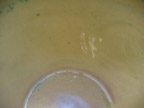
The clay body itself was built from:
- Filtered Sherman clay, sourced from Golden, Colorado
- Ground flint, for structure and thermal stability
- Combined with water and screened into “slip” (a clay slurry)
To this base, Artus added a frit — a soft glass made from borax, whiting, kaolin, and flint. The frit was melted and then powdered by mortar and pestle. Additional materials included whiting, white lead, feldspar, and kaolin, which also produced a bright lead glaze.
For Artus's signature dead matte glaze — the finish that would make Van Briggle famous — the formula called for powdered marble, spar, mitherite, and flint. Artus cautioned that batches must remain small, a constraint that would define the pottery's production methods for years to come.
Copper oxide red was noted specifically for the Ming Blue glaze, one of the pottery's most celebrated colors. All other colorants were sourced from New York. The formula reveals how Artus combined local Colorado materials with specialized chemicals from across the country to achieve his distinctive results.
2. Pre-1920: The Varied Clay Era
In the years before 1920, Van Briggle artisans used a variety of clay types freely, pursuing specific characteristics suited to each piece. This was a period of experimentation and artistic freedom, where the clay body was chosen as part of the creative process rather than dictated by production efficiency.
Unfortunately, most records from this era have been lost to disasters — fires, floods, and the simple passage of time. What we know comes primarily from surviving pieces and the occasional advertisement. Those early ads boasted of the pottery's use of Colorado elements, reflecting the state's natural colors in their work.
Known Clay Examples
- 1903, Type III — Clear glaze inside, fully glazed outside. This corresponds to the formula preserved at the Pioneers Museum.
- 1907, Light Brown — Finished with shellac, giving the surface a warm, slightly glossy appearance distinct from the matte-glazed pieces.
- 1907, Tan — Bisqueware with no glaze or shellac. The bare clay body is visible, showing the natural color and texture of the material.
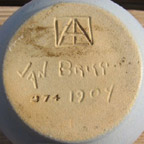
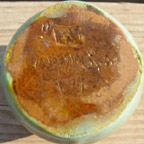
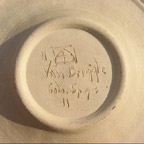
Clay reference photos courtesy clemhull.com
The variety of clay types in pre-1920 pieces makes this era particularly interesting for collectors. If you find a piece with an unusual clay color from this period, it doesn't necessarily mean it's not Van Briggle. The pottery was experimenting constantly, and no single clay color is “correct” for this era.
3. 1920s: Standardization Begins
After Jesse Lewis purchased the pottery on April 19, 1920, the clay body began to standardize — settling mostly into a sandy “buff” color. This shift reflected the new ownership's focus on scaling production and establishing consistent manufacturing processes.
Production expanded significantly during this period, including exports that required “USA” markings on pieces from 1922 to 1926. The Memorial plant underwent major upgrades after a fire, modernizing the facility and further driving standardization.
That said, some 1920s pieces still show other clay types — possibly experimental batches or the result of supply-driven decisions. A few pieces from this decade even exhibit a white clay bottom, a characteristic that wouldn't become standard for another ten years or more.
Visual Progression Through the 1920s
- Early 1920s — Light ruddy brown clay
- Mid/Late 1920s — Sandy buff clay
- Early 1930s — Sandy buff clay (continued)
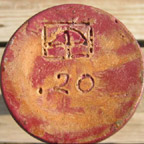
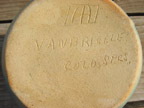
The transition from varied clays to standardized buff was gradual, not abrupt. If you have a piece from the early 1920s with a ruddy brown clay body, it's consistent with the transition period. By the late 1920s, the sandy buff color had become the norm.
4. 1930s–1970: The White Clay Era
Sometime in the 1930s, Van Briggle switched to a fine white clay that would remain the standard body for roughly four decades — the longest single clay era in the pottery's history. This white clay was clean, consistent, and provided an excellent base for the pottery's matte glazes.
Early in this period, older clay bodies were still occasionally sold. Whether these represent old bisque stock finally being glazed and sold, or parallel production runs using different materials, is unknown. Records that might have settled the question were lost in the 1935 floods that devastated Colorado Springs.
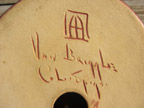
How White Clay Can Appear
The white clay can look quite different depending on surface treatment:
- Clean white — Without shellac, the bare clay appears bright and clean, clearly distinguishable from earlier buff bodies.
- Darkened appearance — With shellac remnant, the white clay can take on a yellowish or tan cast that may initially confuse identification.
- Full shellac coverage — A complete shellac coating can significantly alter the apparent color, making white clay look much darker than it actually is.
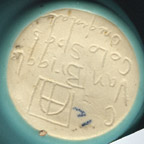
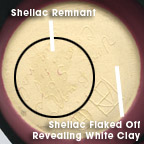
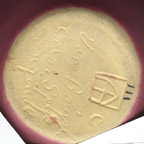
Don't be fooled by shellac. If you're trying to identify the clay body on a piece from this era, look for an uncoated area — often inside the piece or on a spot where the shellac has worn away. The true clay color underneath will tell you whether you're looking at white clay or something else.
5. 1954–1989: The Dryden Clay & “Anna Van” Line
In 1954, Jesse Lewis purchased the Dryden Pottery in Kansas, seeking to tap into the space-age consumer demand for sleek, high-gloss ceramics. Dryden produced high-gloss pieces including Moroccan vases, triple bud vases, rustic barrel mugs, animal figurines, and ultra-modern forms that were worlds away from Van Briggle's traditional Art Nouveau matte aesthetic.
Two Parallel Lines (1954–1968)
For fourteen years, Van Briggle simultaneously produced two distinct product lines:
- Standard matte line — Using white Van Briggle clay
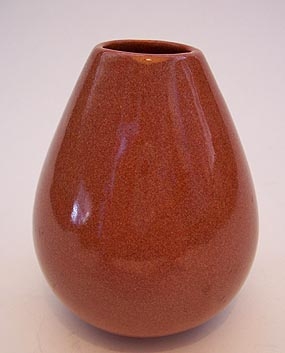
- High-gloss line — Using Dryden clay
Dryden Clay Characteristics
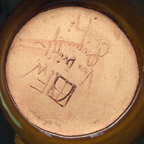
- Ruddy color — A warm, reddish-brown tone distinctly different from Van Briggle's white clay
- Light-bodied — Fred Wills described it as “porous”
- Noticeably less dense — When hefted, Dryden clay pieces feel lighter than similarly sized Van Briggle white clay pieces
- Thin-walled but lighter in substance — The clay allowed for thin construction but without the solid weight of the Van Briggle body
The Compatibility Crisis
Here is where things get complicated. Dryden clay and Dryden glaze were entirely incompatible with Van Briggle clay and Van Briggle glaze. You could not put a Dryden glaze on a Van Briggle body, or vice versa, without disastrous results. This fundamental incompatibility gave rise to the “Anna” line.
The “Anna” name had no connection whatsoever to Anne Van Briggle. It was simply a production identifier used to distinguish the Dryden-clay, high-gloss pieces from the standard Van Briggle matte line. Don't let the name mislead you into thinking these pieces have a special connection to the pottery's co-founder.
Production Timeline
From 1954 to 1956, Dryden produced pieces inscribed “Van Briggle – Colo Spgs” while still manufacturing in Kansas. After 1956, Van Briggle took over production in both Dryden and traditional VB shapes at the Colorado Springs facility.
6. 1968: The Great Clay Modification
After fourteen years of running two incompatible clay and glaze systems side by side, Fred Wills and Joe Jezek finally resolved the compatibility issues in 1968. Their solution was elegant: modify the Van Briggle clay body to accept both glaze systems.
“We did take out one chemical that caused bubbling in the Dryden glaze.”
— Fred Wills, Master Potter (1947–1989)
The modification involved adding darker Dryden clay to the Van Briggle body, reducing the proportion of lighter VB clays, and increasing the frit content. The chemistry was precise and purposeful.
“Joe and I also took out the amount of flint when we added the frit. Flint and frit are both silica that fires at different temperatures.”
— Fred Wills
The resulting clay retained Dryden's ruddy look and porosity. Visually, the modified body was nearly indistinguishable from Dryden clay — but chemically, it was now compatible with both Van Briggle and Dryden glazes.
With the compatibility problem solved, the “Anna” line ended. All subsequent high-gloss pieces received standard Van Briggle markings rather than the separate Anna designation.
The modified Dryden clay was used until 1989, when Dryden glaze formulas were retired entirely. If you have a piece from 1968 to 1989 with a ruddy, porous clay body and standard Van Briggle markings, it's made from this modified formula — not original Dryden clay.
7. 1970–Present: The Buff Clay Era
In 1970, the white clay that had served as Van Briggle's standard body since the 1930s was retired. The replacement exhibits a light beige (“buff”) color, clearly distinguishable from the prior white clay when the two are placed side by side.
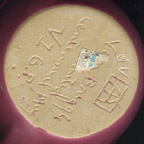
With minor adjustments over the decades, this same basic buff clay body remains in use today. It represents the longest-running clay formula in the pottery's history, spanning from 1970 through the pottery's closure in 2012 and into whatever production has followed.
The buff clay is perhaps the easiest to identify. If the unglazed bottom of your piece shows a warm, light beige color — not white, not ruddy, not sandy — you're almost certainly looking at a post-1970 piece. Compare it against known white-clay era pieces and the difference is immediately apparent.
Clay Color as a Dating Tool
One of the most reliable ways to narrow down the age of a Van Briggle piece is to examine the clay body itself. While it shouldn't be your only dating method, clay color provides a strong first indicator that can confirm or challenge other evidence.
| Era | Clay Color |
|---|---|
| Pre-1920 | Varied — brown, tan, buff, experimental |
| 1920s | Sandy buff |
| 1930s–1970 | Fine white |
| 1954–1989 (Anna line only) | Ruddy, porous (Dryden) |
| 1970–present | Light beige / buff |
Remember that shellac, dirt, and age can all alter the apparent color of clay. Always try to find a clean, uncoated area for identification. The inside of a piece, the foot ring, or a chip (if one exists) will show the true clay color. Combine clay identification with bottom markings and glaze analysis for the most accurate dating.
Sources
The information in this article draws on the following sources:
- Fred Wills, Master Potter at Van Briggle from 1947 to 1989. Fred's firsthand accounts of the Dryden acquisition, the clay modification, and decades of production are irreplaceable primary sources.
- Steve Splittgerber, Curator of the Schleich Redwing Pottery Museum. Steve's expertise in American art pottery has been invaluable in contextualizing Van Briggle's clay history within the broader ceramic tradition.
- Pioneers Museum, Colorado Springs. The museum holds Artus Van Briggle's original 1903 clay formula and other archival materials from the pottery's earliest years.
- Sasicki & Fania, Collectors Encyclopedia of Van Briggle Art Pottery. The most comprehensive published reference for identifying and dating Van Briggle pieces.
- Dorothy McGraw Bogue, The Van Briggle Story. An essential history of the pottery from its founding through the mid-twentieth century.
Further Resources
- Markings & Identification Guide — How to identify and date Van Briggle pottery by its bottom markings.
- Dating Your Van Briggle — A comprehensive guide to determining when your piece was made.
- Glaze History — The evolution of Van Briggle glazes from Artus's dead matte to modern finishes.
- Mark Directory — Visual reference for all known Van Briggle bottom marks by era.
- Contact Us — Have a question about your piece's clay body? Send us photos and we'll help.