Dating Van Briggle Pottery
Van Briggle pottery marks changed over the decades, and learning to read them is the single most useful skill a collector can develop. The marks on the bottom of a piece can tell you not just when it was made, but often who made it and under what conditions.
The key factors for dating a piece include: the style of the script (block vs. cursive), the color and texture of the clay body, the condition and finish of the bottom, finisher numbers, glazer marks, and artist initials. No single factor is definitive on its own, but taken together they paint a reliable picture.
The best printed references for dating Van Briggle pottery are A Collector’s Guide to Van Briggle Pottery, The Collector’s Encyclopedia of Van Briggle Pottery, and The Story Behind the Clay. This guide draws on those sources and decades of collector experience.
Era-by-Era Guide
Jump to a specific period:
1900–1901: First Production Year
Approximately 300 pieces were produced in this first year of operation. These are among the rarest and most sought-after Van Briggle pieces in existence. The marks from this period are entirely hand-incised and reflect the direct involvement of Artus Van Briggle himself.
Typical markings include:
- The conjoined AA logo (Artus and Anne's intertwined initials)
- The company name
- Roman numerals indicating the date
- The full year date
- A stamped shape number
Some bottoms from this period are obscured by glaze or have been ground off. This was not uncommon in early art pottery production. A glazed-over bottom does not automatically disqualify a piece from being first-year production, but it does make authentication more difficult.
1902–1903: Early Expansion
Early 1902 pieces sometimes lack a shape number entirely. By late 1902, the standard marking pattern had developed: the AA logo, "Van Briggle," a shape number (such as #26), and a Roman numeral III indicating the third year of production.
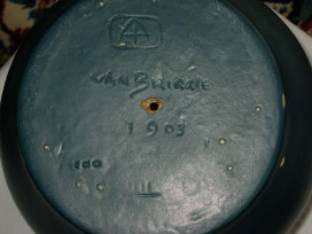
In 1903, a die-stamped shape number was added to the markings, making pieces from this year easier to catalog. The marks remain hand-incised overall, but the addition of die-stamping shows the pottery beginning to systematize its production.
A glazed "T" on the bottom of some pieces from this period may indicate the work of Thomas Alton, one of the early pottery workers. This mark is uncommon and adds historical interest to any piece that carries it.
1904: The Final Year of Artus
This is one of the most significant years in Van Briggle history. Artus Van Briggle died in 1904, making pieces from this year transitional. Some were produced under his direct supervision; others were completed after his death.
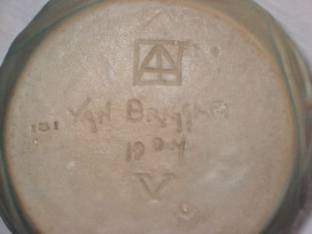
Key characteristics:
- Shape number 104 appears on some pieces
- Experimental glaze pieces may carry black ink test markings
- A rare bronze base exists on certain pieces from this period
After Artus's death, the "V" in "Van Briggle" was altered on subsequent markings. This subtle change in letterform is one of the indicators that can help distinguish pieces made during Artus's lifetime from those produced after. Look carefully at the formation of the capital V when comparing early marks.
1905: After Artus
Production continued under Anne Van Briggle's guidance. The shape number remained part of the standard markings. When bottoms were glazed over (obscuring the incised marks), the markings were reapplied by hand in black ink.
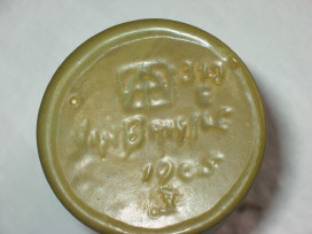
Clay type designations appear on some pieces from this year, including the codes V, X, and VV. These indicate different clay bodies being tested or used in production. These designations would be dropped the following year.
1906: "Colo. Springs" Added
A significant change in 1906: "Colo. Springs" (or "Colorado Springs") was added to the bottom markings for the first time. This geographic identifier would remain a standard element of Van Briggle marks for the rest of the pottery's history.
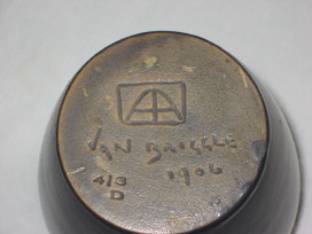
Clay type designations (V, X, VV) were dropped this year. The turquoise glaze, a variant of the Ming Blue family, makes its first appearance. Turquoise-glazed pieces from 1906 are particularly collectible.
1907–1912: Expansion Era
This period shows the pottery growing into a more structured operation. Marks typically include the company name, the AA logo, and finisher numbers flanking the logo on either side.
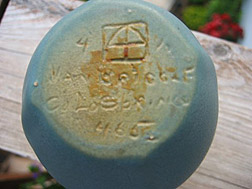
Shape numbers from this era are three digits:
- 465, 654, 671, 683, 696, 735, 763 (among others)
Some pieces have a white wash on the bottom, and heavy grinding of the base is common. Copper-clad pieces also appear during this period, representing a distinctive decorative technique.
The date was dropped from markings around mid-1907. This is important: if a piece carries a full date and three-digit shape numbers, it likely dates to 1907 or earlier. After mid-1907, you lose the date as a direct reference point and must rely on other characteristics for precise dating within this range.
1912–1918: The Teens (Ned Curtis Era)
Under Ned Curtis's ownership, the pottery entered a prolific period, especially between 1915 and 1920. The marking style shifted considerably.
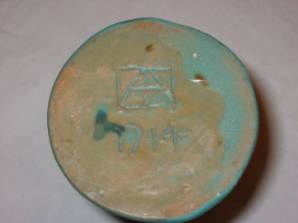
Typical characteristics:
- Mostly just the VB logo and date; occasional design numbers
- Dark clay is typical of this period
- Glaze residue on the bottom is common
- Cursive script replaces block lettering
- Large, hand-incised AA logo and year
Novelty and souvenir pieces were introduced during this era. Visitors to the pottery could choose their own glaze color and even add personal initials to pieces. These personalized souvenir items are interesting curiosities but are generally less valuable than standard production pieces.
In 1917, experimental production codes appear, written in black ink on the bottom. Examples include codes like "9-E." These codes are not fully documented and their exact meaning remains a subject of collector research.
1919–1921
Marks from this brief period follow a consistent pattern: the VB logo, "Van Briggle," plus a two-digit date — "19," "20," or "21." These are among the easier years to identify precisely because of the return of date markings.
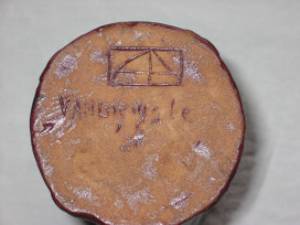
1922–1926: "USA" Mark Added
Beginning in 1922, "USA" was added to the bottom markings. This was required for pieces being exported and is a reliable dating indicator. If a piece carries the USA mark, it dates to 1922 or later.
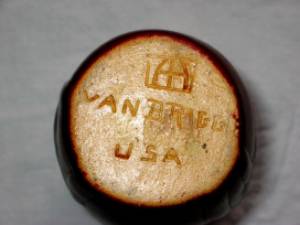
An unusual variant from this period is known with a larger, carved-out AA logo. This variant is uncommon and may represent an experimental marking approach. Its rarity makes it of particular interest to advanced collectors.
Late 1920s–Early 1930s
Pieces from this transitional period have distinctive bottom characteristics: rough, sandy, unglazed clay bottoms with a narrower AA monogram and smaller script than earlier eras.
How to distinguish 1920s from 1930s within this range:
- 1920s pieces tend to use block lettering
- 1930s pieces tend to use script lettering
World's Fair novelty items from 1933 are known. These souvenir pieces were produced for the Century of Progress exhibition in Chicago and carry distinctive markings related to the fair. They are collectible both as Van Briggle pottery and as World's Fair memorabilia.
1930s–1940s
During this period, the clay color and bottom finish shifted noticeably. The dark clay of the teens gave way to lighter tones, and the overall quality of bottom finishing became more consistent.
Pieces from the 1940s can often be identified through purchase records, the specific shade and texture of the clay body, and finisher initials that begin appearing on bottoms during this decade. If you have provenance documentation (receipts, family records, gift inscriptions), these become especially valuable for pinning down a date within this range.
1940s–1960s: Mid-Century Production
Standard markings from this period include:
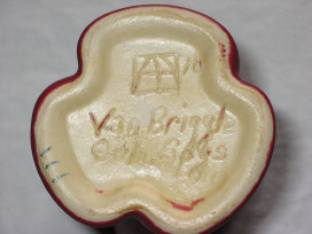
- VB logo
- "Van Briggle Colo. Spgs."
- Mixed block and script lettering
- Finisher initials and batch numbers
- Thrower's initials on handthrown pieces
- Ink marks identifying the glaze artist
Important distinction: Numbers flanking the AA logo during this period are batch numbers, not shape numbers. This is a common source of confusion because pieces from the 1907–1912 era also have numbers flanking the logo — but in that earlier era, they are shape numbers. Misreading batch numbers as shape numbers can lead to significant dating errors. See the Key Dating Tips section below for more on this.
1952–1968: The "Anna Van" Period
During this period, a special mark was used for a line of high-gloss pieces: "Anna Van Briggle." These pieces used a different clay body (Dryden clay) and received a high-gloss glaze finish, distinguishing them from the traditional matte-finish Van Briggle line.
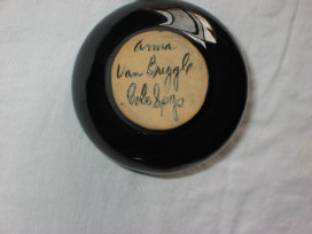
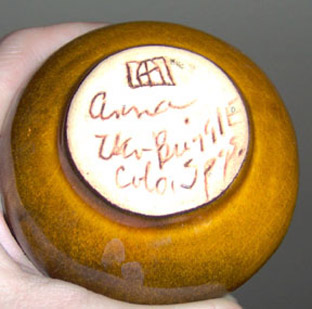
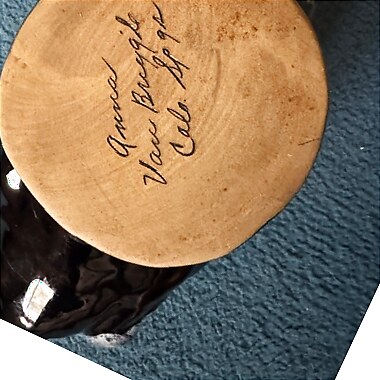
Despite the name, the "Anna Van Briggle" mark has no direct connection to Anne Van Briggle, Artus's wife. The name was chosen specifically to designate the high-gloss production line and differentiate it from the standard matte pieces.
Some pieces from this era carry both the standard VB logo and the "Anna Van Briggle" mark. This combination is atypical and is believed to be accidental — pieces that were inadvertently double-marked during production. While unusual, these double-marked pieces are interesting curiosities rather than indicators of special status.
1956: Gold Ore Glaze
In 1956, Van Briggle produced a special series using a gold ore glaze. These pieces are marked with either a circled "G" or the full inscription "gold ore glaze, Van Briggle, Colo. Spgs."
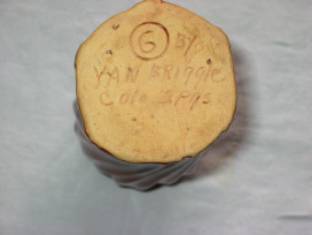
The gold ore glaze produces a distinctive metallic warmth in the finish. These pieces represent one of Van Briggle's periodic experiments with special glaze formulations and are sought after by collectors interested in the pottery's glaze history.
1960s
The 1960s saw the introduction of glazer codes written in ink on the bottom of pieces. These typically appear as Roman numeral codes such as "IV." The codes identify which glazer worked on the piece.
Pieces by Fred Wills from this era carry his "FW" initials. Wills was a notable potter at Van Briggle, and his pieces are recognized by collectors.
Novelty items produced for organizations and special events also appear during the 1960s. These pieces often carry additional markings related to the commissioning organization.
1970–1999
Standard markings from this long period include:
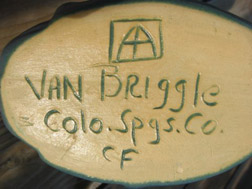
- VB logo
- "Van Briggle Colo. Spgs."
- Various combinations of print and script lettering
- Finisher and thrower initials
A significant material change occurred in 1970: the white clay body that had been used for decades was replaced by a buff (beige) clay. Clay colour is among the most reliable physical indicators for dating, but it runs in one direction only. White clay reliably predates 1970. Buff clay does not reliably mean 1970 or later, because the pottery also used a sandy buff body in the 1920s and into the early 1930s, before the white era began.
So a buff bottom leaves you with two candidate windows, roughly 1920 to the early 1930s, and 1970 onward. Separating them is easy in practice, because almost everything else differs. The 1920s pieces tend to have rough, sandy, unglazed bottoms and a smaller AA monogram; the post-1970 pieces carry the later mark layout, usually with an AA inside a rectangular border and a finisher's initials alongside. Use the mark, the bottom finish, and the glaze to decide which window you are in, then let the clay confirm it rather than lead.
1984–1985: Rare Dated Pieces
In a departure from the usual practice of the late twentieth century, some pieces from 1984 and 1985 carry the year as part of their bottom markings: the VB logo, "Van Briggle," "Colo. Spgs.," plus "84" or "85."
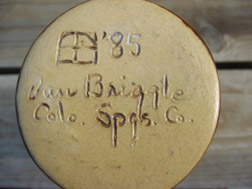
These dated pieces are rare within the broader 1970–1999 production. The return of date marking, even briefly, makes these pieces easier to pin down than most late-century Van Briggle. If you find a piece with "84" or "85" on the bottom, you can date it with unusual precision for this era.
2000–Present: The Letter-Code System
Beginning in 2000, Van Briggle introduced a unique dating system using letters from the word VANBRIGGLE paired with single digits. Each letter corresponds to a decade, and the digit indicates the specific year within that decade.
The centennial year (2000) received a special mark: "VB100" to celebrate 100 years of production.
The decade codes work as follows:
| Decade | Letter | Example |
|---|---|---|
| 2001–2009 | V | V1 = 2001, V9 = 2009 |
| 2010–2019 | A | A0 = 2010, A9 = 2019 |
| 2020–2029 | N | N0 = 2020, N9 = 2029 |
| 2030–2039 | B | B0 = 2030, B9 = 2039 |
| 2040–2049 | R | R0 = 2040, R9 = 2049 |
| 2050–2059 | I | I0 = 2050, I9 = 2059 |
| 2060–2069 | G | G0 = 2060, G9 = 2069 (first G in VANBRIGGLE) |
| 2070–2079 | G | G0 = 2070, G9 = 2079 (second G in VANBRIGGLE) |
| 2080–2089 | L | L0 = 2080, L9 = 2089 |
| 2090–2099 | E | E0 = 2090, E9 = 2099 |
The "V" used in the 2001–2009 date codes has a serif on the left branch to prevent confusion with the Roman numeral VI. When examining a piece, look for this serif to confirm you are reading a date code rather than a Roman numeral.
Buyer beware: Pieces with these modern date codes are sometimes sold as older pieces by resellers, either through ignorance or intent. If you encounter a piece claimed to be mid-century or earlier but the bottom carries a letter-digit code from this system, the piece is from 2000 or later regardless of what the seller says.
Key Dating Tips Summary
When you have a piece in hand and want to estimate its age, work through these indicators systematically. No single factor is conclusive, but together they will narrow your range considerably.
Script Style
One of the best tools for dating. Block lettering suggests 1920s or earlier (or certain mid-century periods). Cursive script appears in the teens and 1930s. Mixed block and script is typical of the 1940s–1960s. Familiarize yourself with the script styles of each era, and you can often place a piece within a decade at a glance.
Clay Color
- Dark clay: Teens era (1912–1920)
- Buff or sandy clay: 1920s–1930s
- White clay: 1930s–1970
- Buff/beige clay: 1970–present
Note that buff appears twice on this list. White clay is the one-way clue: it reliably means pre-1970. A buff bottom is ambiguous on its own, so read it alongside the mark style and the bottom finish.
Bottom Condition
The condition of the bottom itself is a dating tool. Heavy grinding is common in the 1907–1912 period. White wash on the bottom also appears in that era. Glaze residue on the bottom is typical of the teens. Rough, sandy, unglazed bottoms point to the late 1920s and early 1930s. Each era left its own fingerprint on how the bottom was finished.
Finisher & Etcher Initials
Individual worker initials begin appearing consistently from the 1940s onward. If you see small initials on the bottom that are not the AA monogram, the piece is most likely mid-century or later. These initials can sometimes be matched to known potters and finishers, adding provenance value.
Shape Numbers
Early pieces (1900–1906) have two- to three-digit shape numbers. By 1908–1911, three-digit numbers are standard. Shape numbers are a useful cross-reference when combined with other indicators, as many shapes were produced across multiple eras.
The Flanking Numbers Trap
This is one of the most common sources of dating confusion. Both the 1907–1912 and 1940s–1960s eras have numbers flanking the AA logo. But they mean different things:
- 1907–1912: The flanking numbers are shape numbers (identifying the design)
- 1940s–1960s: The flanking numbers are batch numbers (identifying the production run)
Use clay color, script style, and bottom finish to determine which era you are looking at. Do not assume flanking numbers alone indicate early production.
Further Resources
- Markings & Identification Guide — High-resolution reference photos of Van Briggle bottom marks from 1901 to 2004, including museum-quality images from the Metropolitan Museum of Art.
- Artist & Maker Mark Directory — A directory of known artist initials, finisher marks, and glazer codes found on Van Briggle pottery.
- Glaze Reference Guide — Comprehensive guide to Van Briggle glaze colors, formulations, and how they changed over the decades.
- Clay Body History — The evolution of Van Briggle clay bodies from the early dark clays through white and buff eras.
- Contact Us — Have a piece you need help identifying or dating? Send us photos of the bottom marks and we will do our best to help.