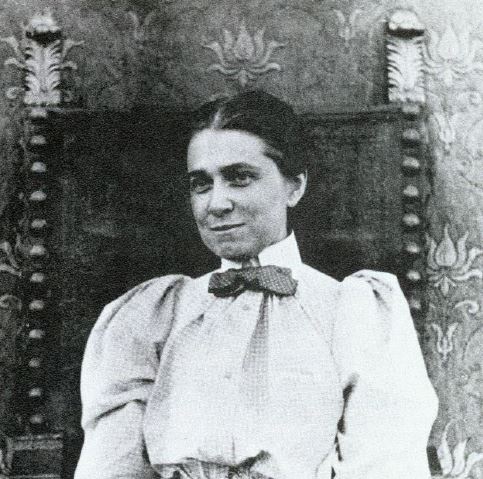
The standard telling of Van Briggle’s history centers on Artus — the brilliant artist, the matte glaze breakthrough, the tragic death from tuberculosis at 35. But the pottery didn’t survive because of Artus. It survived because of Anne.
Anne Lawrence Gregory wasn’t a supporting character in someone else’s story. She was a trained artist who exhibited at the Paris Salon, designed roughly half the pottery’s forms, created the iconic “AA” mark, built the memorial pottery building, and ran the company for eight years after Artus’s death. Without her, Van Briggle Pottery would have ended in 1904.
An Artist in Her Own Right
Anne was born July 11, 1868, in Plattsburgh, New York. She studied landscape painting with Charles Melville Dewey in New York, then moved to Europe — first to the Victoria-Lyceum in Berlin, where she studied oil painting, watercolors, and clay modeling, then to the Academie Colarossi in Paris by 1894.
Her work was good enough to be accepted at the Paris Salon — a significant achievement for any artist, let alone an American woman in the 1890s.
It was in Paris that she met Artus Van Briggle, who was studying at the Academie Julian on a scholarship funded by Rookwood Pottery’s founder, Maria Longworth Storer. They became engaged in Paris. When they returned to the United States in 1896, they went separate ways — Artus back to Rookwood in Cincinnati, Anne to a teaching post in Pennsylvania where she taught art, French, and German.
Colorado Springs
In 1900, Anne moved to Colorado Springs to join Artus, who had relocated there for his health. She became Art Supervisor at Colorado Springs High School. They married on June 18, 1902, in a ceremony on Cheyenne Mountain at a place known as Helen Hunt Jackson’s Garden.
By this point, the pottery was in operation. Anne wasn’t just Artus’s wife — she was his collaborator. She mastered his glaze formulas and the technical side of ceramic production. She designed pottery forms. Between 1900 and 1912, Anne was responsible for approximately half of the nearly 900 pottery designs the company developed.
The “AA” mark that appears on every piece of Van Briggle pottery? Anne designed it — to symbolize the unity of Artus and Anne.
After Artus
Artus died on July 4, 1904, at age 35. Just before his death, the pottery had won two gold, one silver, and two bronze medals at the 1904 Louisiana Purchase Exposition in St. Louis.
The company reorganized in late 1904, with Anne becoming president. She didn’t just maintain what Artus had started — she expanded it. She continued producing his original designs using molds while adding designs of her own. She hired skilled assistants, including her former art student Emma Kinkead as a designer, and relied on established potters like Ambrose Schlegel.
In 1907, she made a critical business decision: she started the company producing art tiles. Artus had developed a process for making tiles just before his death, and Anne sketched out the designs. The tiles proved popular with local builders in Colorado Springs’ growing housing market, and they became a significant revenue stream.
The Memorial Pottery Building
Anne’s most visible achievement is the building itself. She secured financing and a building site — land donated by General William Jackson Palmer, the founder of Colorado Springs — and worked with Dutch architect Nicolaas van den Arend to design what would become one of the most important tile installations in America.
Construction began in the summer of 1907, and the building was completed in September 1908. The grand opening on December 3, 1908, drew approximately 600 people.
The building is extraordinary. Anne personally designed and fabricated more than 5,000 tile and terra cotta components for it — machine-pressed tiles, hand-pressed polychrome tiles, molded three-dimensional tiles, relief-carved scenes of Colorado landscapes including Pikes Peak and the Garden of the Gods. She worked with Emma Kinkead for more than a year to produce these tiles.
The building featured tile fireplaces, tile floors, tile wall panels, a sculptural cat, and a gargoyle. Tile scholar Richard Mohr judged it in 2007 to be one of America’s four or five most important art tile installations. It was listed on the National Register of Historic Places in 2009.
Later Years
Anne remarried on July 14, 1908, to Etienne A. Ritter, a Swiss-born mining engineer. She continued leading the pottery until 1912, when she leased operations to Edmund deForest Curtis. The pottery declared bankruptcy in 1913 under Curtis’s management.
Anne returned to teaching — at Colorado College in 1916, and in 1919 she became one of five founding trustees of the Broadmoor Art Academy, which became a major regional art institution. She sold the company in 1922 and moved to Denver in 1923, where she devoted her remaining years to painting western landscapes.
She died on November 15, 1929, in Denver, at age 61. Just months before her death, she had introduced Vance Kirkland — the founder of what would become the Kirkland Museum — to Van Briggle pottery. He became one of the earliest serious collectors.
What Collectors Should Know
A few things are worth noting for collectors:
The “Anna Van Briggle” marks that appear on pottery from 1955 to 1968 have nothing to do with Anne herself. The “Anna” mark was used during that period to distinguish a different type of clay and glaze in production. Don’t confuse it with Anne’s actual legacy.
Anne’s own pottery designs are among the most interesting in the Van Briggle catalog, and pieces from her period (1904-1912) are highly collectible. The memorial building she created still stands on Glen Avenue in Colorado Springs, now owned by Colorado College. If you’re in the area, it’s worth seeing — the tilework alone is remarkable.
For more on dating your Van Briggle pieces, including marks from Anne’s era, see our Markings & Identification Guide. The Collector’s Encyclopedia of Van Briggle Art Pottery is especially useful for identifying pieces from the 1904-1912 period when Anne was running the pottery, and The Story Behind the Clay covers many of the specialty and commissioned pieces that originated under her leadership.