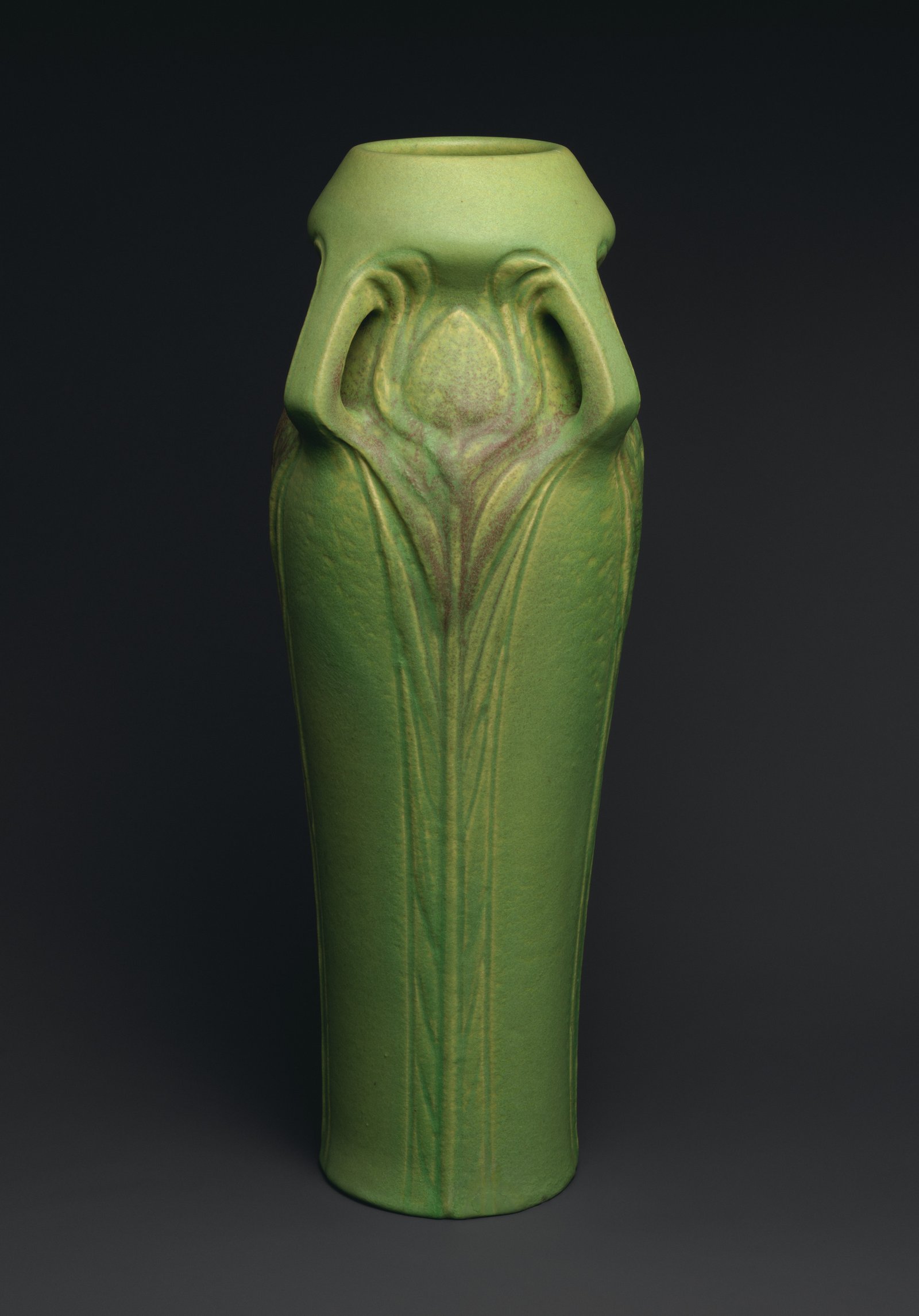
Everything collectors value most about Van Briggle pottery comes back to one thing: the glaze.
That soft, velvety, non-reflective surface — smooth as marble to the touch but without any gloss — is what set Van Briggle apart from every other American pottery of its era. Artus Van Briggle spent the better part of a decade trying to recreate it, working through failing health and across two continents. When he finally succeeded, it changed American ceramics.
The Chinese Originals
The glazes that obsessed Artus were from China’s Ming Dynasty (1368-1644). These “dead” or “dead matte” glazes had a quality that defied easy description — a rich, saturated color with absolutely no shine. The surface felt like satin under your fingers. The technique for producing them had been lost for centuries by the time Artus first encountered examples in European museum collections.
What made them so difficult to recreate was that the matte quality wasn’t a simple surface treatment — it had to be built into the glaze chemistry itself.
Paris, 1893-1896
Artus arrived in Paris on a scholarship funded by Maria Longworth Storer, the founder of Rookwood Pottery. He was there to study painting at the Academie Julian, but his real education happened in the museums.
He spent hours at the Louvre and the Sevres Ceramics Museums, studying Ming Dynasty pieces with those impossible glazes. He also couldn’t have been unaware of what was happening in contemporary French ceramics — artists like Edmond Lachenal had introduced new matte effects in Paris during exactly these years. But Lachenal’s approach was fundamentally different: he achieved his matte surfaces through a hydrofluoric acid bath after firing. Artus wanted something more authentic — a matte quality that was part of the glaze itself, created in the fire.
He returned to the United States in 1896 with an obsession he couldn’t shake.
The Rookwood Experiments
Back at Rookwood Pottery in Cincinnati, Artus resumed his official work — highly detailed portrait paintings in Rookwood’s Standard Glaze, the dark, glossy style that had made the company famous. But on the side, he began his matte glaze experiments.
He made progress. Albert Valentien, head of Rookwood’s decorating department, later confirmed that Artus “introduced mat glazing to Rookwood and was responsible for the very first objects with such glazes executed there.” By 1898, he had developed his own dull glaze, and some of his experimental pieces were shown to critical acclaim.
He also created the first version of his famous Lorelei vase at Rookwood in 1898 — a piece that announced his mature style, one in which the decoration was modeled into the clay rather than painted on the surface. This was the key artistic breakthrough that would define Van Briggle: the decoration and the form became inseparable.
But the glazes weren’t yet what he wanted. He had achieved “some success” but was “seeking a standard of perfection not yet achieved.”
Colorado Springs
In March 1899, tuberculosis forced Artus to leave Rookwood for the dry mountain air of Colorado Springs. He was 30 years old.
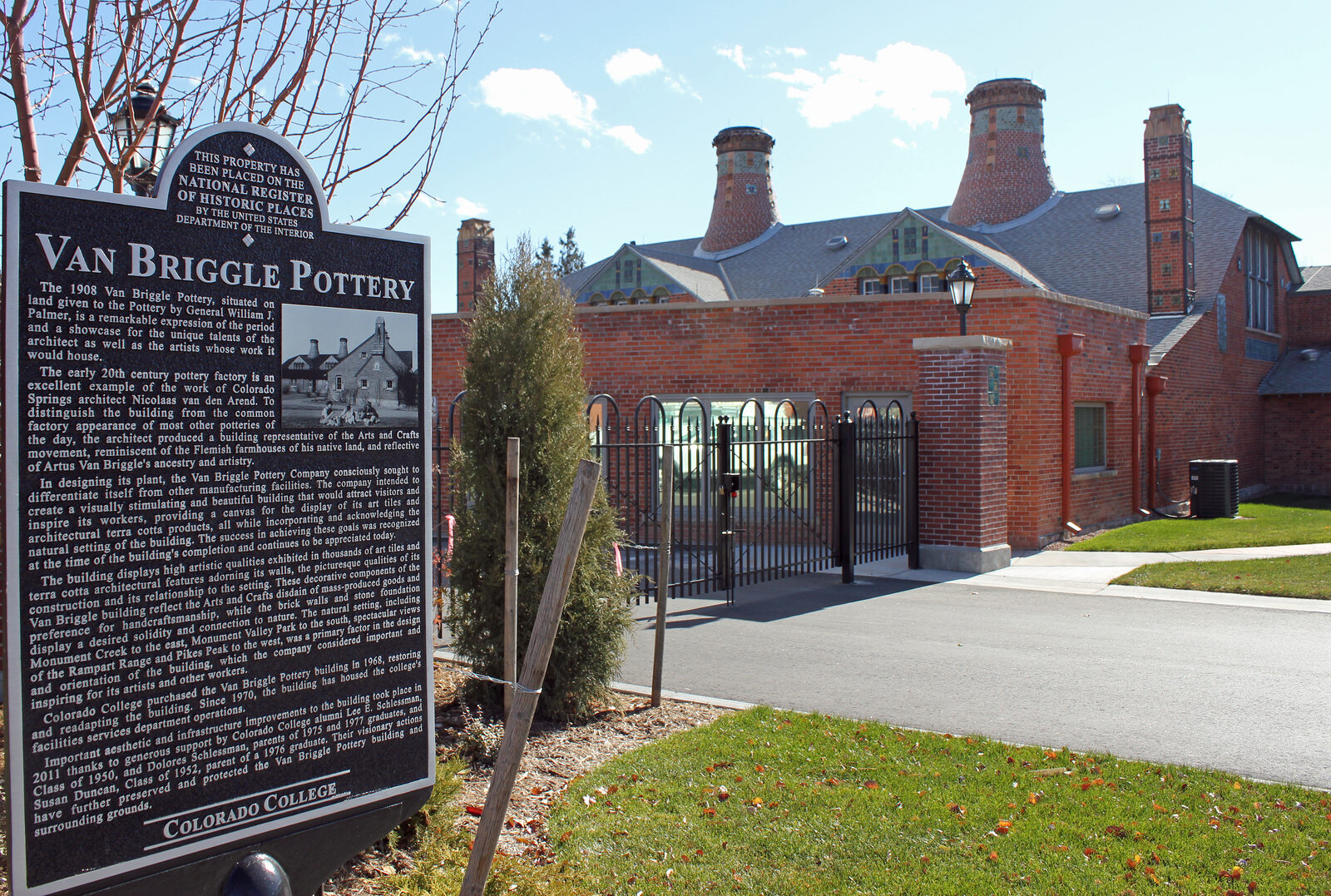
He continued his experiments there, working largely alone — “designing, casting, and firing the pieces almost entirely by himself.” A critical collaborator was Professor William Strieby, head of the Chemistry and Metallurgy Department at Colorado College, who provided laboratory space, chemical advice, and an assayer’s muffle kiln in the basement of the college’s first building.
Strieby’s son Maurice later recalled “seeing this kiln in action many times, with father peeking through the port holes at the temperature gauges.” He noted this was “where success was first achieved with the ‘Matte’ glaze.”
The local Colorado clay turned out to be well-suited for the work. Artus spent approximately two years of intensive experimentation.
The Breakthrough
No exact date was recorded, but one day in the spring of 1901, Artus reached into the kiln and finally held what he’d been chasing for nearly a decade. The dead matte glaze — rich, saturated, velvety, and perfect. The first pieces created in this tradition in centuries. The first ever made in America.
By late 1901, approximately 300 pieces were fired and placed on the commercial market. Van Briggle Pottery was open.
”A Supreme Discovery in Modern Ceramics”
In 1903, Artus sent 24 pieces to the Paris Salon. All 24 were accepted — remarkable because art for commercial purposes was usually rejected, even from firms like Tiffany’s. The pottery won two gold medals, one silver, and twelve bronze.
The Despondency vase — design number 9, a man wrapped around the rim in a pose of anguish — won first place. European art critics proclaimed the glazes “a supreme discovery in modern ceramics.” The story goes that the Louvre purchased the Despondency for $3,000, though this has never been independently verified through museum records.
The following year at the 1904 Louisiana Purchase Exposition in St. Louis, Van Briggle won two more gold medals, one silver, and two bronze — and would have won the grand prix if not for a rule prohibiting it for first-time exhibitors.
Artus died on July 4, 1904, just as news of the St. Louis awards arrived. He was 35.
Why This Matters to Collectors
The matte glaze is the reason Van Briggle exists as a collectible pottery. It’s what separates a $100,000 early piece from a $50 production piece.
Early Van Briggle matte glazes (1901-1912) have a depth and complexity that later production couldn’t match. The primary glaze was often oversprayed with a complementary secondary color accent, creating subtle color variations across the surface. Some pieces show suspended crystalline effects or mottled and curdled surfaces that are extraordinarily beautiful.
Later in the pottery’s history, glossy glazes were introduced — particularly after 1955, with colors like Honey Gold, Jet Black, and Trout Lake Green. These are perfectly fine pieces of pottery, but they represent a fundamentally different product than what Artus achieved.
One useful detail for collectors: the glaze color known as “Mountain Craig Brown” — a honey-brown with light green overspray — has a confirmed cutoff date. The formula was lost in a 1935 flood that destroyed records and molds. If a piece has that color, it dates to before 1935.
For more on identifying and dating Van Briggle pieces by their marks, see our Markings & Identification Guide. To see early matte-glazed pieces up close, visit our Gallery.
For a deeper understanding of ceramic glaze chemistry, Daniel Rhodes’ Clay and Glazes for the Potter remains the standard reference — it’s the book that explains why matte and gloss glazes behave the way they do.