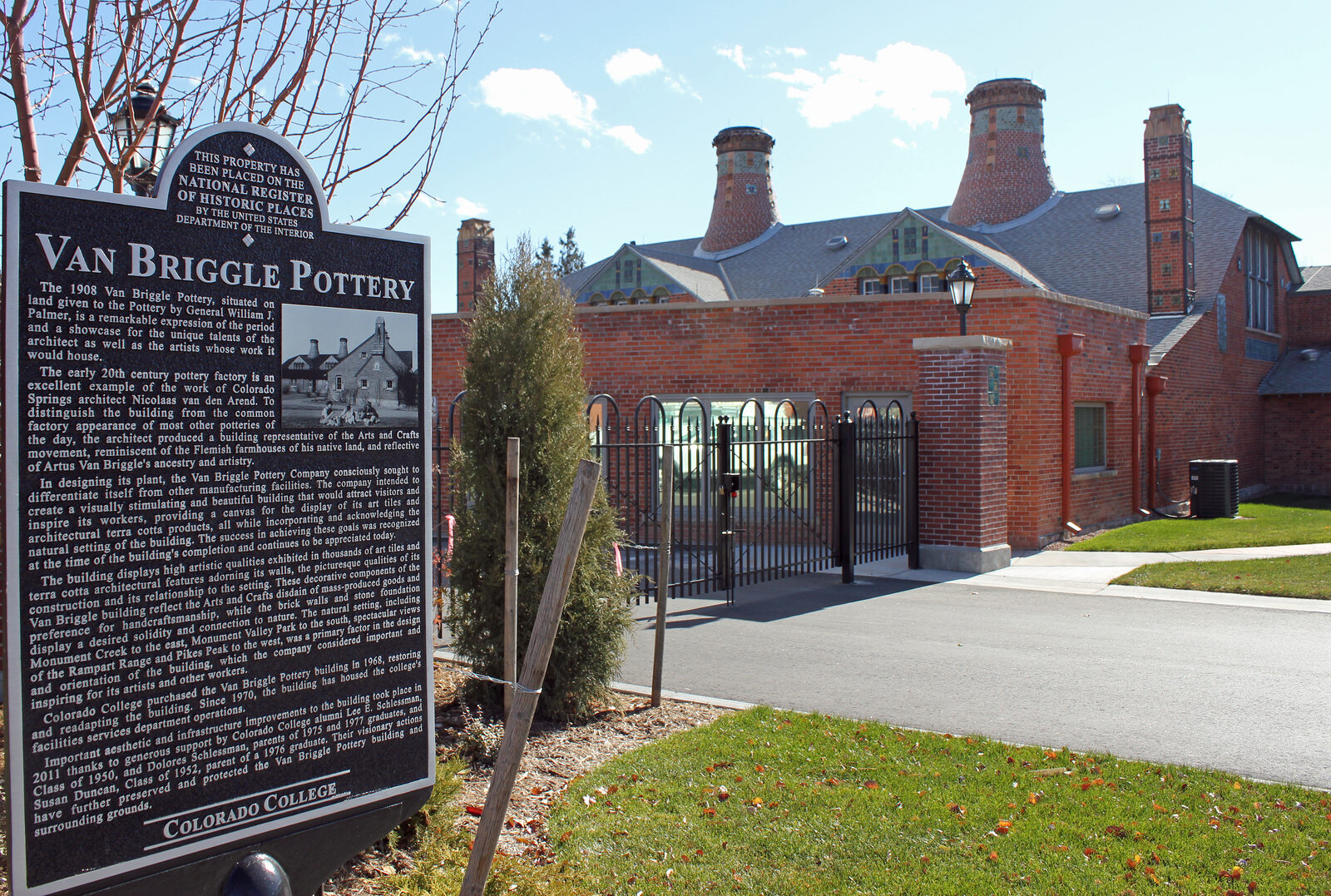
You can’t understand Van Briggle without understanding Rookwood. Artus Van Briggle spent twelve years at America’s most prestigious art pottery before striking out on his own. Everything he learned there — the techniques, the chemistry, the business of ceramics — he carried to Colorado Springs. And the thing he couldn’t achieve at Rookwood became the foundation of Van Briggle’s identity.
Rookwood: The Preeminent American Pottery
Rookwood Pottery was founded in 1880 in Cincinnati, Ohio, by Maria Longworth Nichols — later Maria Longworth Nichols Storer after her second marriage. She came from one of Cincinnati’s wealthiest families and had been inspired by ceramics she saw at the 1876 Philadelphia Centennial Exhibition.
Rookwood quickly became the standard against which all American art pottery was measured. It won a Gold Medal at the 1889 Paris Exposition — a shock to critics who didn’t think American ceramics could compete internationally. It won the Grand Prix at the 1900 Exposition Universelle in Paris. It won the highest award at the 1893 World’s Columbian Exposition in Chicago. Over its 87-year original existence, Rookwood produced over a million pieces in more than 4,000 shapes. It remains the most extensively represented pottery in the Smithsonian collection.
Rookwood’s signature was the Standard Glaze — a warm, dark, Rembrandtesque finish over delicately painted underglaze decorations. Flowers, birds, insects, portraits, landscapes — all painted on the pottery surface beneath a clear gloss glaze. The pottery employed some of the finest decorative artists in America, and each piece was individually signed by its decorator.
Artus at Rookwood, 1887-1899
Artus Van Briggle arrived in Cincinnati in 1886 at age 17. He first worked decorating china dolls at the Arnold Fairyland Doll Store while attending the Cincinnati Art School. He briefly apprenticed at Avon Pottery under the ceramic chemist Karl Langenbeck — an important connection, since Langenbeck was one of the first people to bring rigorous chemistry to American glaze development. His book The Chemistry of Pottery (1895) was foundational.
In 1887, Artus moved to Rookwood, where he would stay for twelve years. He rose to become one of their leading decorators, working in the naturalistic Standard Glaze style — particularly skilled at highly detailed portrait work, including notable Native American portrait vases.
Maria Storer recognized his talent and became his patron. In 1893, she funded his trip to Paris to study painting at the Academie Julian. It was an extraordinary investment in a young artist, and it changed everything.
Paris and What He Found There
Artus went to Paris to study painting, but his real discovery happened in the museums. At the Louvre and the Sevres Ceramics Museums, he encountered Chinese Ming Dynasty ceramics with dead matte glazes — surfaces that had a rich, saturated color with absolutely no gloss, smooth as satin to the touch. The technique for producing them had been lost for centuries.
He also met Anne Lawrence Gregory, a fellow American art student at the Academie Colarossi. They became engaged.
He returned to Rookwood in 1896 as a different artist. He continued his official work in the Standard Glaze, but on the side he began experimenting with matte glazes. He also started developing a new approach to pottery design — instead of painting decorations on the surface (the Rookwood way), he began modeling decorations into the clay form itself, making decoration and form inseparable. This was the artistic leap that would define Van Briggle.
Albert Valentien, head of Rookwood’s decorating department, later confirmed that Artus “introduced mat glazing to Rookwood and was responsible for the very first objects with such glazes executed there.” He created the first version of his famous Lorelei vase at Rookwood in 1898 — an early announcement of his mature style.
Why He Left
Tuberculosis forced the decision. The disease was a death sentence in the 19th century, and the dry mountain air of Colorado Springs was considered therapeutic. In March 1899, Artus left Rookwood — at what should have been the peak of his career — and headed west.
He was 30 years old. He had at most five years to live, though he didn’t know the exact timeline.
What He Took with Him
From Rookwood, Artus carried:
Technical knowledge: Painting, modeling clay, mold-making, kiln firing, glaze chemistry, and the operations of running a professional pottery.
Chemical discipline: Through Karl Langenbeck’s influence and his own experiments, he understood that pottery was a melding of art and science. He would apply this rigorously in Colorado, working with Professor William Strieby at Colorado College to perfect his matte glaze formulas.
The matte glaze foundation: He’d made real progress at Rookwood but hadn’t yet achieved the perfection he wanted. That final push would happen in Colorado in 1901.
A fundamentally different artistic vision: At Rookwood, the pot surface was a canvas for painting. At Van Briggle, the clay form itself would be the art — sculpture and vessel fused into one object. This is the key distinction between the two potteries, and it’s what collectors should understand when comparing them.
Rookwood vs. Van Briggle: A Collector’s Comparison
If you collect one, you should at least know the other:
| Rookwood | Van Briggle | |
|---|---|---|
| Finish | High-gloss Standard Glaze (signature) | Satin matte (signature) |
| Decoration | Painted under the glaze | Modeled in relief, integral to the form |
| Style | Painterly, naturalistic | Sculptural, Art Nouveau |
| Typical subjects | Portraits, florals, landscapes | Human figures, stylized botanicals |
| What you collect | Individual decorators’ work | Forms, glazes, and designs |
| Most valuable period | Pre-1915 | Pre-1904 (Artus’s lifetime) |
Maria Longworth Storer’s support didn’t end when Artus left Rookwood. She helped raise capital to establish Van Briggle Pottery in Colorado Springs — patron to the last.
We also have a post about a rare Rookwood tile that surfaced at a collector’s estate, if you’re interested in seeing how the two potteries’ legacies continue to intersect in the collecting world.
If you want to go deeper on Rookwood and the other American art potteries Artus knew, our art pottery reference books guide gathers the standard references for each.
Further Reading
If you want to go deeper into these two potteries, these are the essential references:
- Van Briggle: The Collector’s Encyclopedia of Van Briggle Art Pottery by Richard Sasicki covers over 800 pieces with identification and dating information.
- Rookwood: Rookwood Pottery at the Philadelphia Museum of Art by Nancy Owen is a beautifully illustrated study, and Rookwood Pottery: The Glaze Lines by Anita Ellis is the definitive guide to Rookwood’s glazes.
- Both: Kovels’ American Art Pottery covers the full landscape of American art pottery including both Rookwood and Van Briggle.