Historical Ephemera & Photographs
The history of Van Briggle Pottery is preserved not just in the ceramics themselves but in a rich archive of photographs, catalogs, advertisements, and documents. These ephemera offer windows into the daily operations of the pottery, the people who worked there, and how the company presented itself to the world over more than a century.
What follows is a guided tour through the surviving documentary record — organized by subject and, within each subject, roughly by date. Think of it as walking through a museum exhibit devoted not to the pottery itself, but to everything that surrounded it: the faces, the buildings, the printed materials, and the paper trail left behind by more than a hundred years of continuous operation in Colorado Springs.
For company history woven around the surviving artifacts, The Collector’s Encyclopedia of Van Briggle Art Pottery covers the full narrative from founding through modern production. For the broader context of how Van Briggle’s marketing and catalog materials compared to its contemporaries, Kovels’ American Art Pottery is the standard cross-maker reference.
Contents
Jump to a section:
1. The People of Van Briggle
Behind every piece of Van Briggle pottery were the hands that shaped it. The photographic record captures several of the key figures across the pottery's history — at their wheels, in the studio, and occasionally in more formal settings. These images are among the most valuable ephemera for understanding the human side of the operation.
Artus Van Briggle
The founder himself is documented in several surviving photographs and artworks, each offering a different facet of the man behind the pottery.
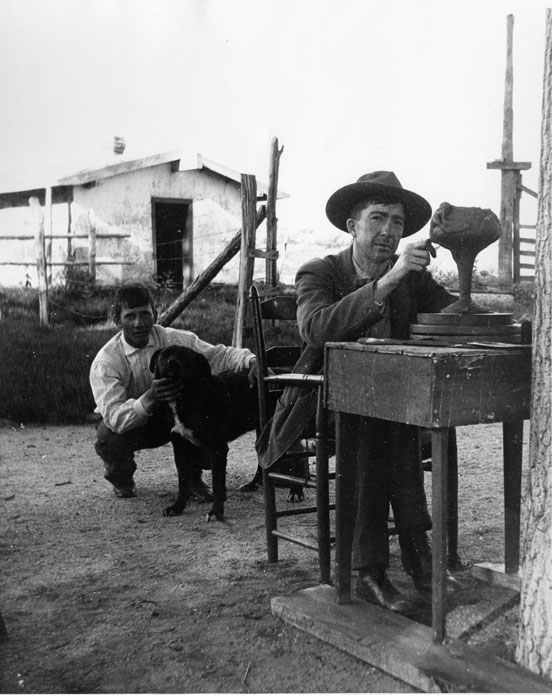
Circa 1900
Photograph at Chico Basin Ranch. Artus is shown holding Shape #1, the Toast Cup — the very first form he designed for the pottery. The Chico Basin Ranch, southeast of Colorado Springs, was a place he frequented for its open air and light. This photograph is one of the few showing him with a finished piece in hand.
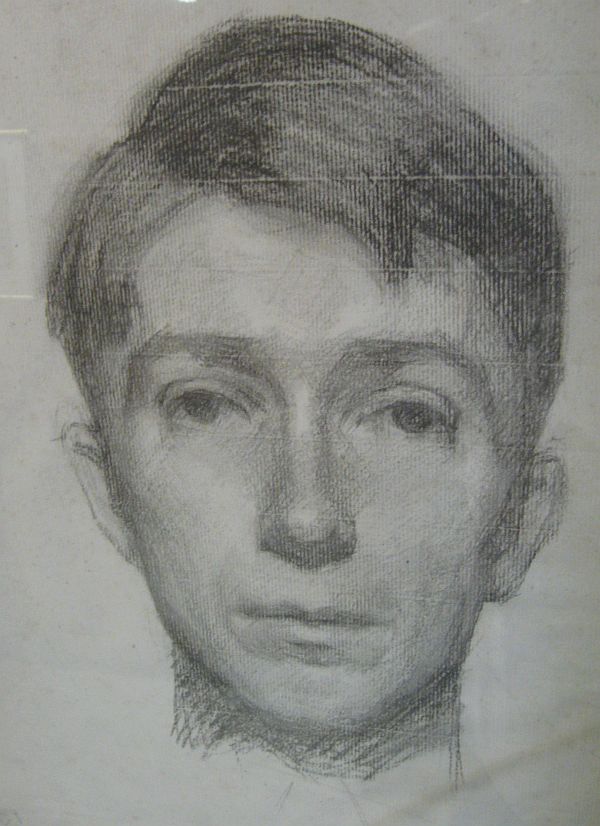
Undated
Pencil portrait. A drawn portrait of Artus, likely executed by a contemporary. The medium is pencil on paper, rendered in a naturalistic style consistent with late nineteenth-century portraiture. It shows Artus as a young man, before the tuberculosis that would claim his life had taken its full toll.
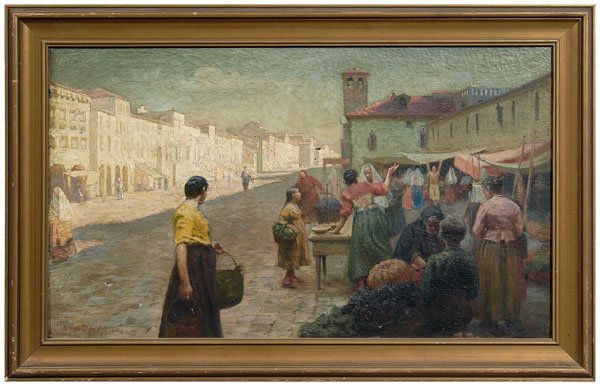
1894
Oil painting, Paris. Painted while Artus was studying at the Académie Julian in Paris on a scholarship from the Avon Pottery. This oil dates to the period when he was absorbing the Art Nouveau influences that would shape Van Briggle's aesthetic. It is a rare document of his artistic life before pottery became his sole focus.
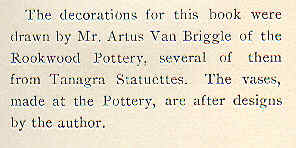
1898
Book illustration cover page. Before devoting himself entirely to ceramics, Artus illustrated a book in 1898. The surviving cover page shows his skill as a draftsman and his comfort with the flowing organic forms that would later define Van Briggle pottery.
1902
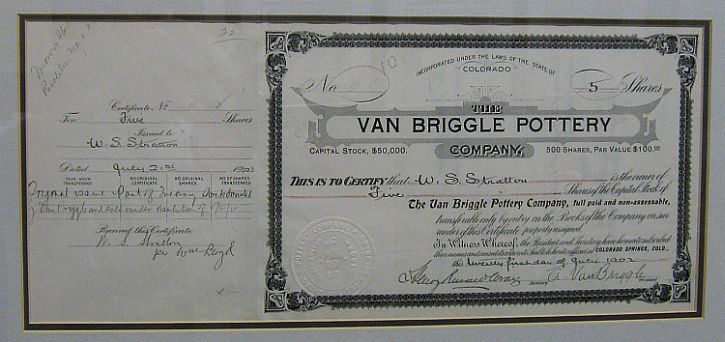
Stock certificate signed by Artus. An original 1902 stock certificate for 5 shares, issued to William S. Stratton — the Cripple Creek mining magnate who was one of the pottery's earliest and most important financial backers. Artus's signature appears on the certificate, making it one of the few surviving documents bearing his hand.
1904
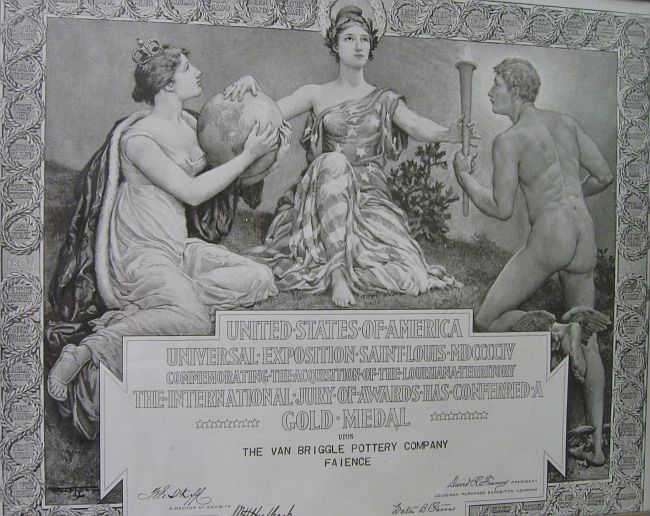
Gold medal certificate, St. Louis Exposition. The certificate accompanying the gold medal awarded to Van Briggle Pottery at the 1904 Louisiana Purchase Exposition (World's Fair) in St. Louis. This was the pottery's crowning achievement in Artus's lifetime, though he died before the fair opened. The award validated his years of glaze experimentation and cemented the pottery's reputation.
Ambrose Schlegel, Master Potter
Schlegel was one of the most important potters in Van Briggle's history, working at the pottery during a critical period of growth and transition. Multiple photographs document his work at the wheel and his role in major commissions.
Circa 1915
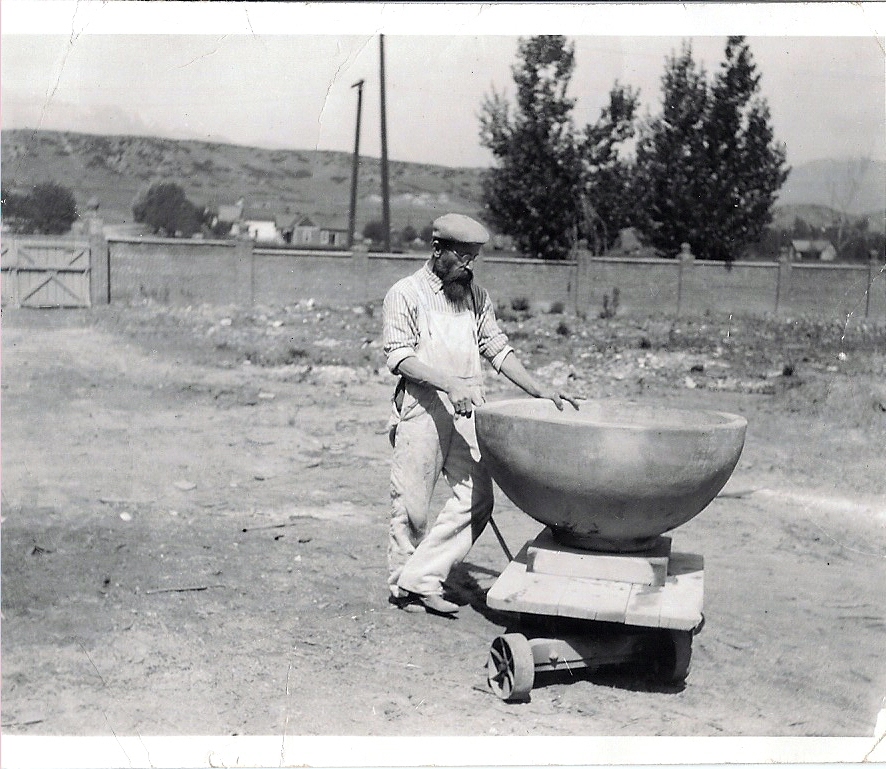
With a large urn for a Pueblo hotel. Schlegel is shown alongside a monumental urn produced for a hotel in Pueblo, Colorado. The scale of the piece — it dwarfs the potter standing beside it — demonstrates the ambition of Van Briggle's architectural and commercial commissions during this era.
1920s–1930s
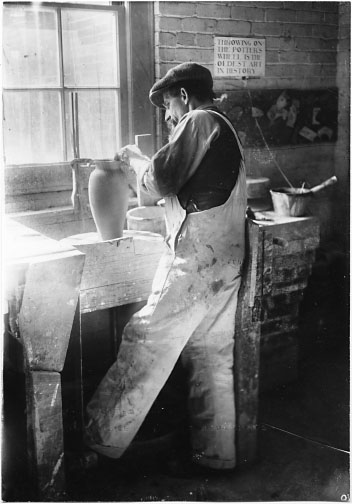
At the potter's wheel. Multiple photographs from the 1920s and 1930s show Schlegel seated at his wheel, hands on clay, in the working interior of the Memorial Plant. These are classic pottery-workshop images: the concentration on his face, the half-formed vessel taking shape, the tools and bats arranged nearby. Several seated and working photographs exist from this period, each showing him at different stages of the throwing process.
Fred Wills, Master Potter
Wills was a prominent figure at Van Briggle during the mid-twentieth century, and his initials ("FW") appear on the bottoms of many pieces from the 1950s and 1960s. He is one of the best-documented potters in the company's later history.
1950s–1960s
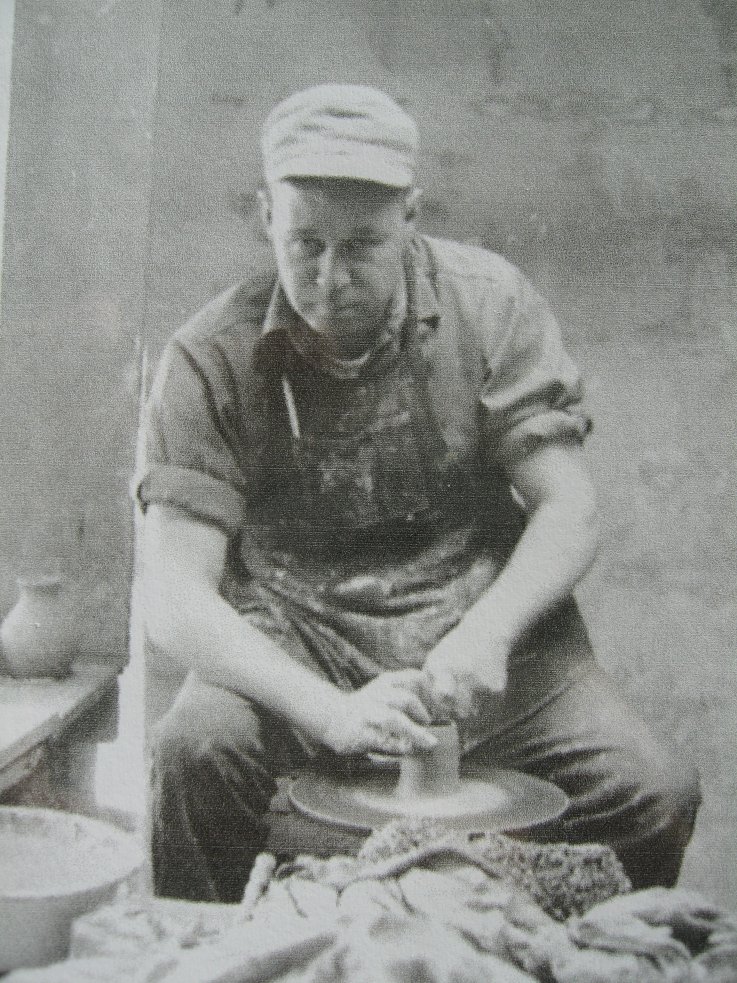
Throwing vases. Multiple photographs exist of Wills at the wheel, throwing vases in the Van Briggle workshop. These images capture the mid-century production environment: the wheel, the clay, the shelves of drying ware behind him. His technique and posture reflect decades of experience.
Circa 1960s
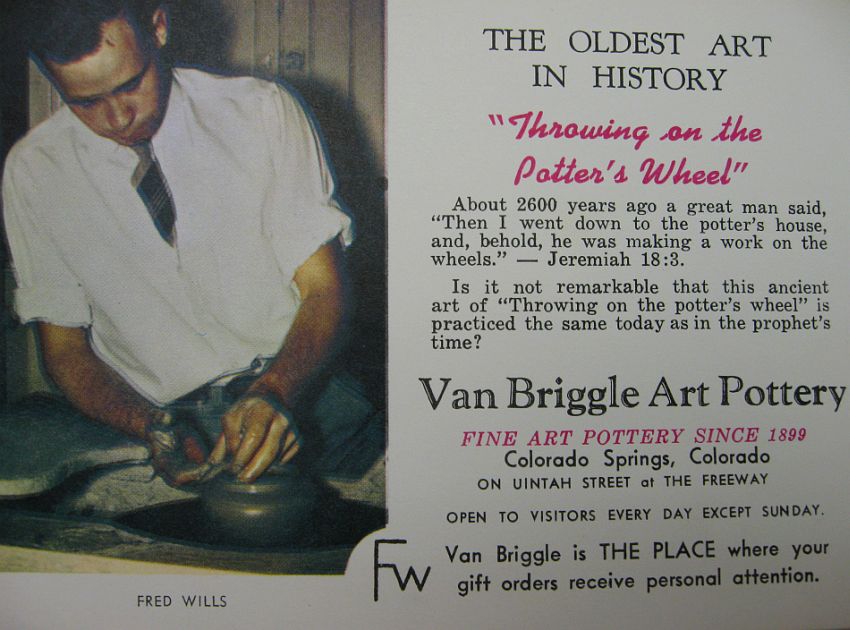
Advertising postcard. Wills was featured on a promotional postcard showing him at the demonstration wheel. These postcards were sold or given away at the pottery's tourist shop and helped put a human face on the Van Briggle operation during the height of the tourist era.
Undated
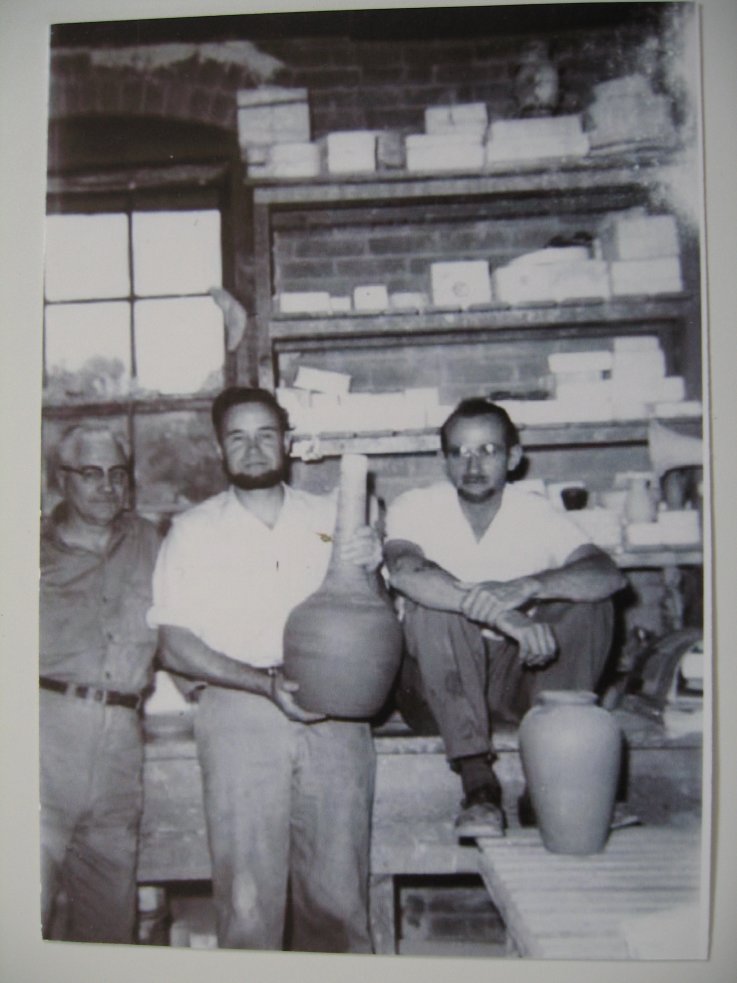
Photographed alongside Clem Hull. A photograph showing Wills with Clem Hull, another key figure in the pottery's history. The image captures the camaraderie and working relationship between the people who kept Van Briggle running through its middle decades.
Other Notable People
Beyond the principal figures, the photographic record preserves glimpses of other individuals who contributed to Van Briggle's story.
Otis Wills — photographed at the demonstration wheel, where he showed visitors the art of pottery-making. The demonstration wheel was a central feature of the tourist experience at Van Briggle for decades.
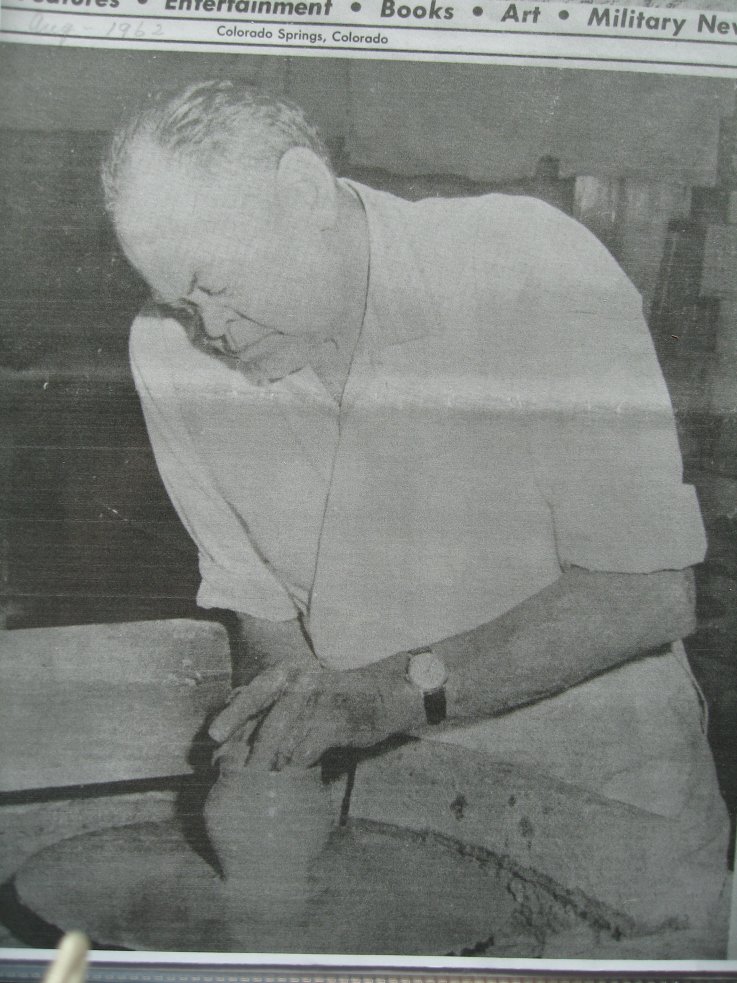
Harry Bangs — photographed at the potter's wheel. Bangs was among the skilled throwers who maintained Van Briggle's production standards through the mid-century period.
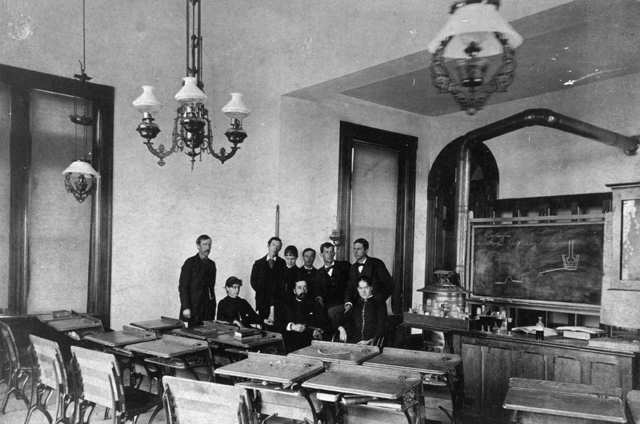
William Strieby's chemistry lab at Colorado College. A photograph documenting the laboratory where Artus Van Briggle conducted his early glaze experiments. Strieby, a professor at Colorado College, provided Artus access to the lab facilities where the famous dead matte glazes were developed. This image connects Van Briggle's art directly to the scientific experimentation that made it possible.
1901
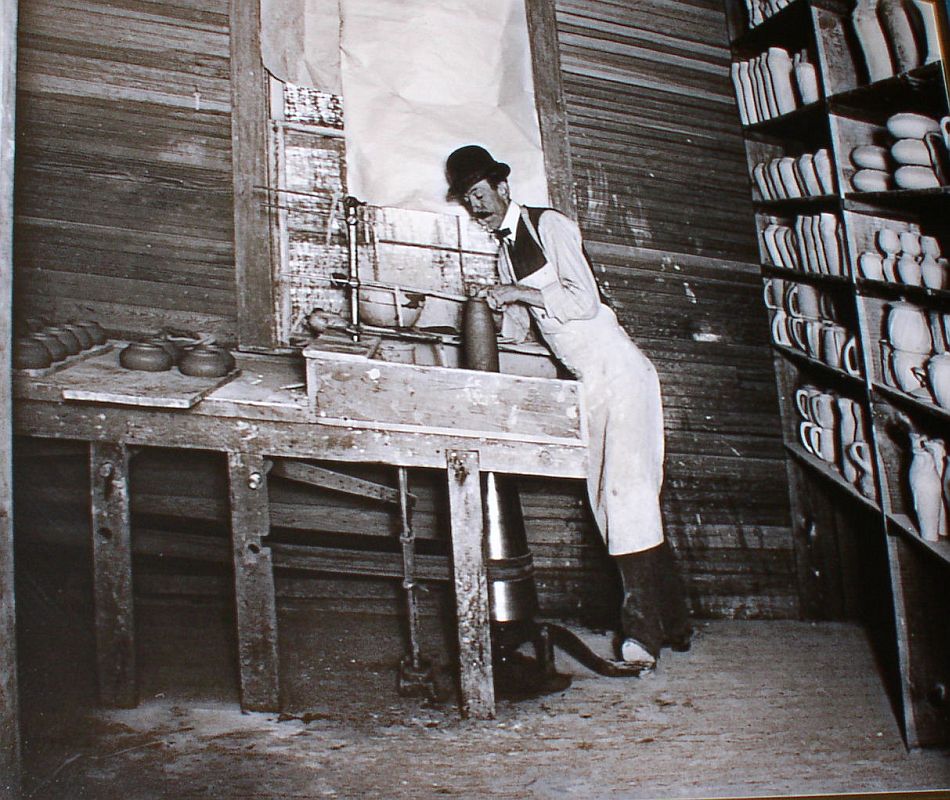
Potter at the wheel. An early photograph from the pottery's first year of operation, showing a potter at the wheel in what was likely the original Nevada Avenue studio. First-year photographs are exceedingly rare.
Early era
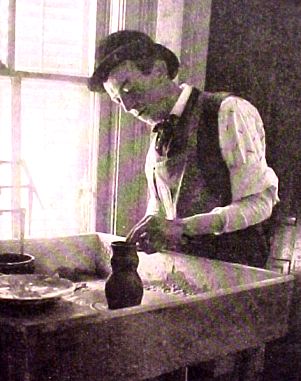
Group photo of workers. An early group photograph of Van Briggle employees, capturing the small team that constituted the pottery's workforce in its formative years. These early group photos are invaluable for understanding the scale and character of the original operation.

2. The Factory & Buildings
Van Briggle pottery was made in several buildings over its long history, and photographs of these structures document not just architecture but the evolving scale and ambition of the operation. From a modest studio on Nevada Avenue to the grand Memorial Plant on South 21st Street, each building tells part of the story.
The Original Nevada Avenue Studio
The pottery's first home was a small building on North Nevada Avenue in Colorado Springs. It was here that Artus Van Briggle began commercial production in 1901, working with a handful of assistants in cramped quarters.
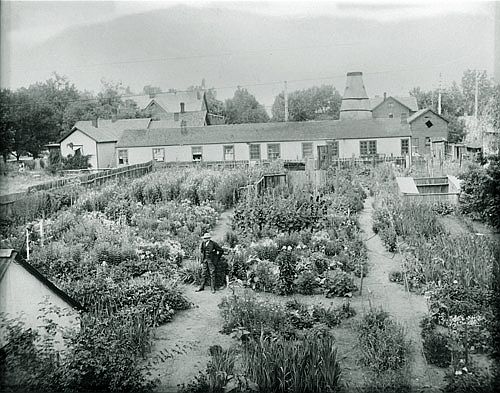
Garden behind the building. A photograph survives showing the garden area behind the Nevada Avenue studio. Even in these earliest days, the grounds reflected the aesthetic sensibility that permeated everything Artus touched. The garden provided a quiet retreat from the heat and dust of the kilns just inside.
The Memorial Plant
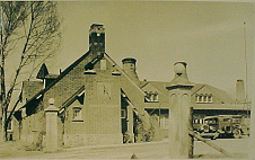
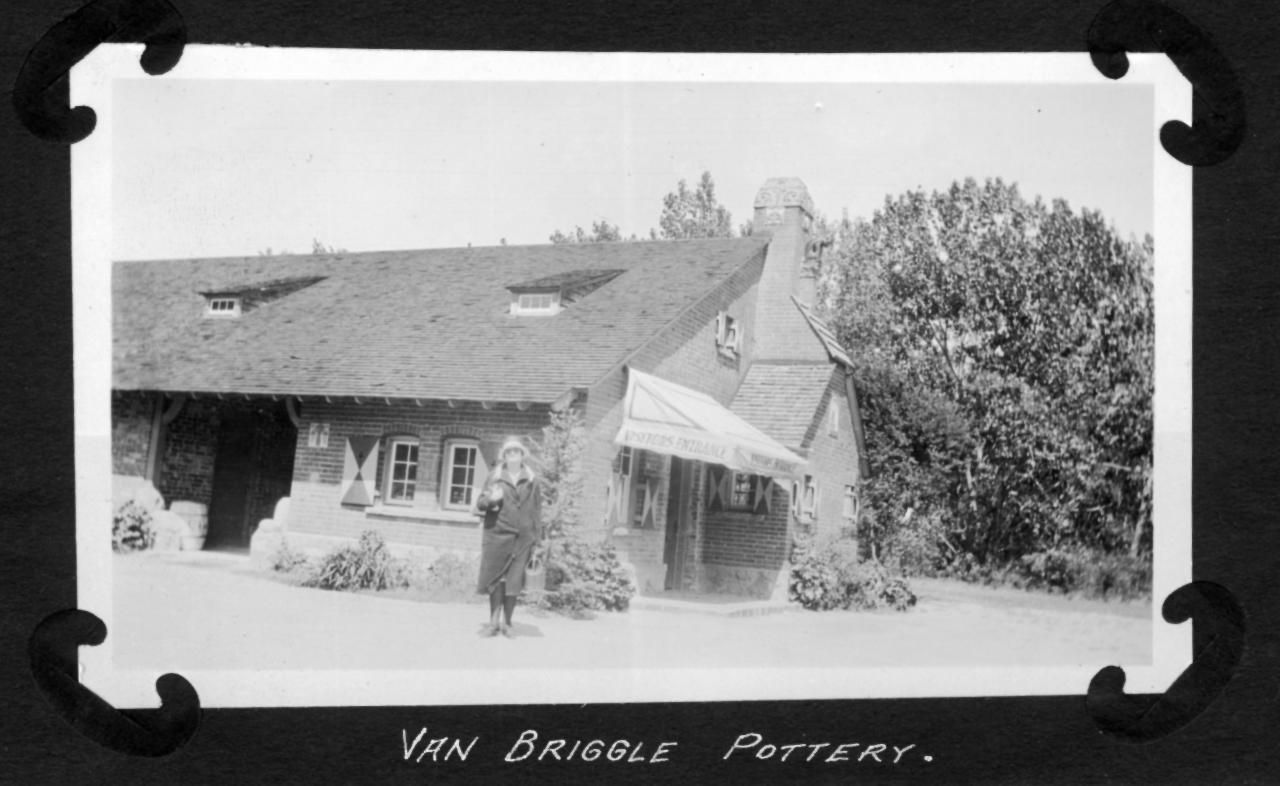
After Artus's death, Anne Van Briggle oversaw construction of a new, purpose-built pottery facility — the Memorial Plant — which became the company's iconic home. The building itself, with its Dutch Colonial architecture and prominent chimneys, became a landmark in Colorado Springs. It is documented extensively in photographs spanning nearly a century.
Circa 1908
Exterior view. An early photograph of the Memorial Plant shortly after its construction. The building appears fresh and new, its distinctive architectural features clearly visible against the Colorado sky.
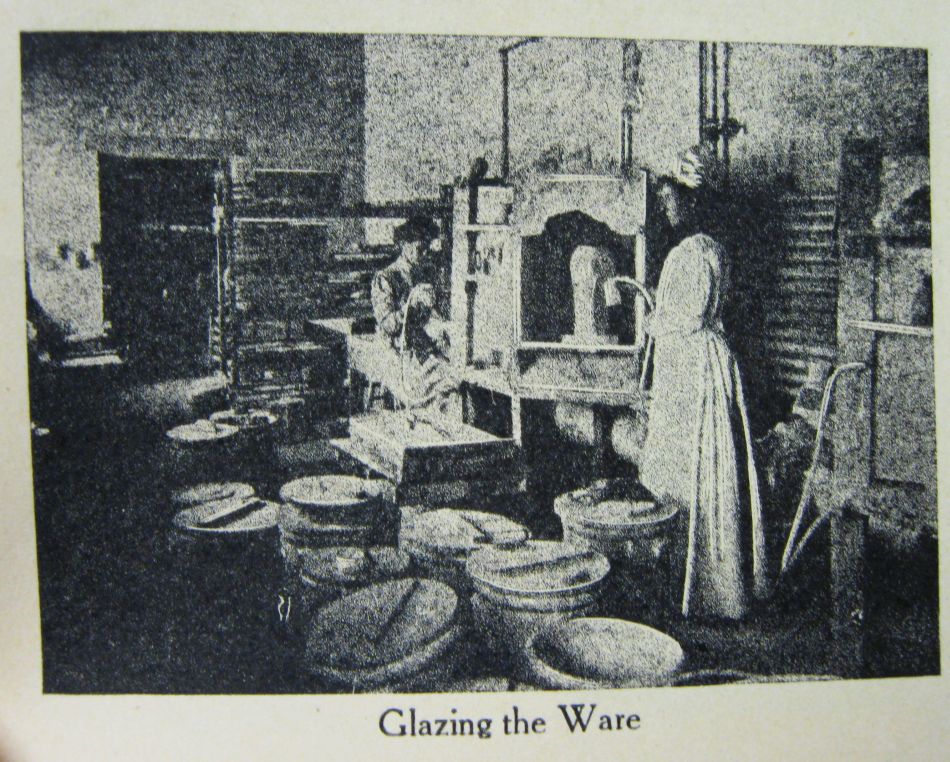
Circa 1908
Interior: glaze area. A view of the glazing room, where pieces received their distinctive matte finishes. Shelves of bisque-fired ware await glazing, and the tools and containers of the glazer's trade are visible throughout.
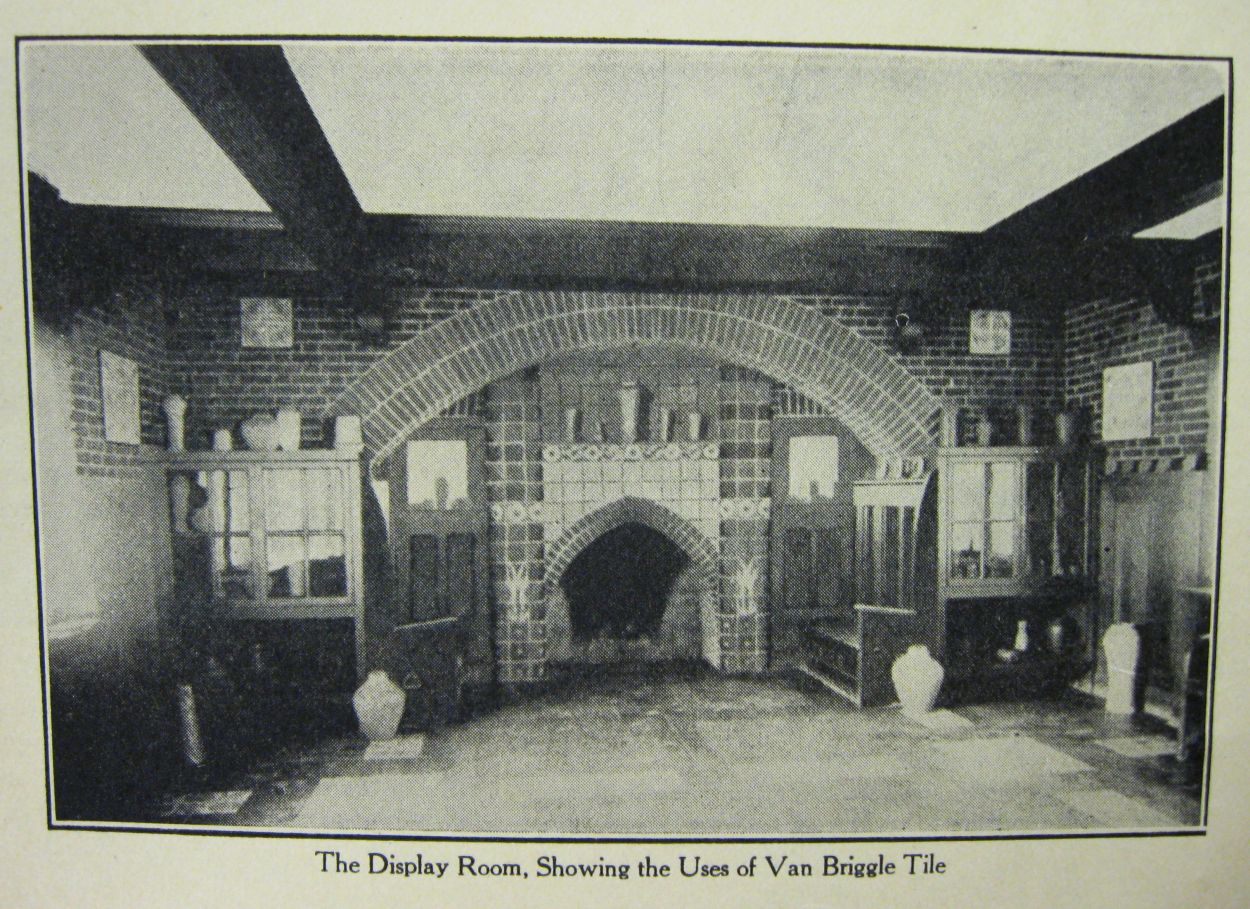
Circa 1908
Sales room. Multiple views survive of the Memorial Plant's sales room, where finished pieces were displayed for visitors and buyers. The photographs show shelves lined with vases, bowls, and decorative pieces — effectively a catalog in three dimensions. These images are particularly useful for identifying forms and glazes that were in production during this period.
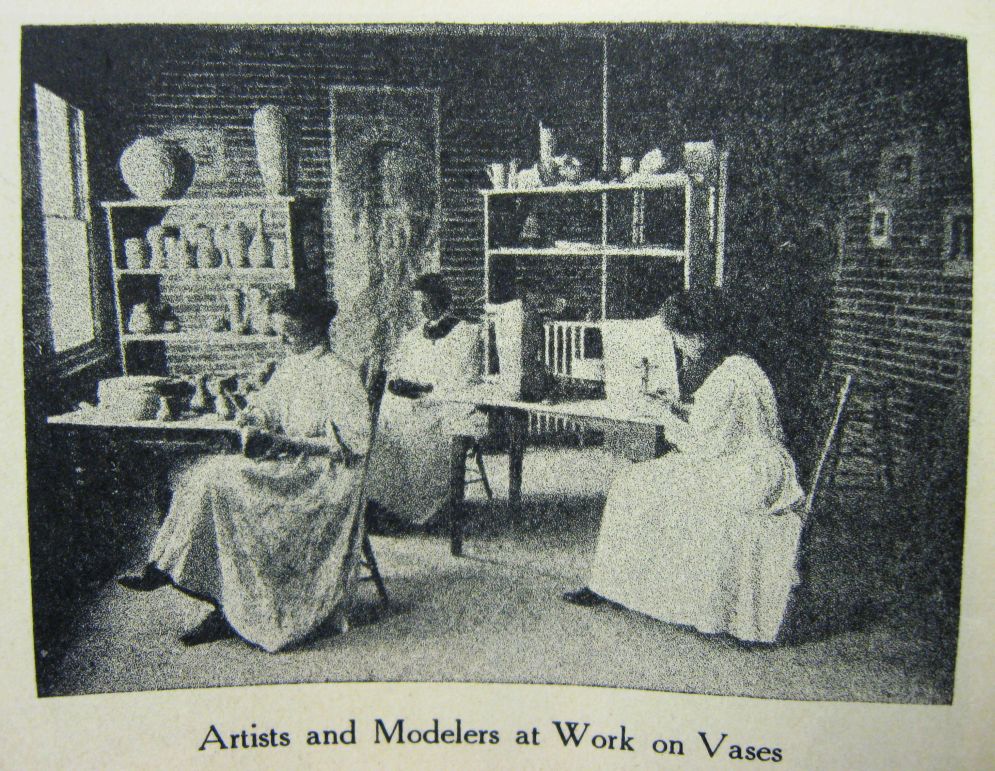
Circa 1908
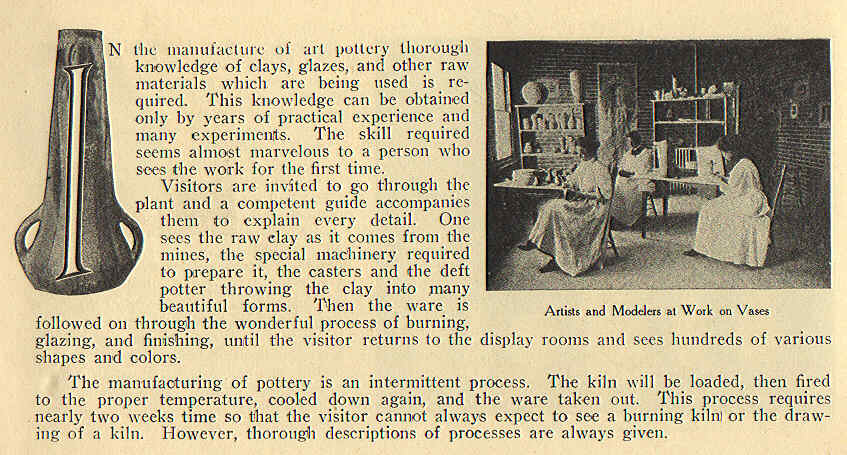
Modelers finishing clay bodies. A workshop photograph showing modelers at their benches, hand-finishing clay forms before they went to the kiln. This image captures the labor-intensive nature of Van Briggle production: each piece was handled individually, shaped and refined by skilled hands.
1920s
Exterior view. The Memorial Plant a decade and a half into its life, now weathered and settled into its site. Mature landscaping has grown up around the building, softening its lines.
1952
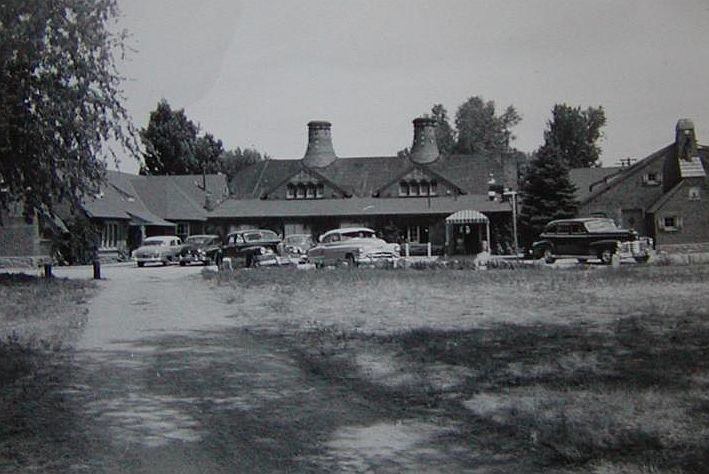
Exterior view. A mid-century photograph showing the plant in its mature years. By this time the building had been a fixture in Colorado Springs for over four decades and was well established as a tourist attraction.
Tourist era
Tourist-era photographs. From the 1950s onward, the pottery leaned heavily into tourism. Photographs from this period show the building as visitors would have encountered it: signage, parking areas, and the welcoming entrance that drew travelers off the highway for a look at pottery being made.
The 1935 Flood
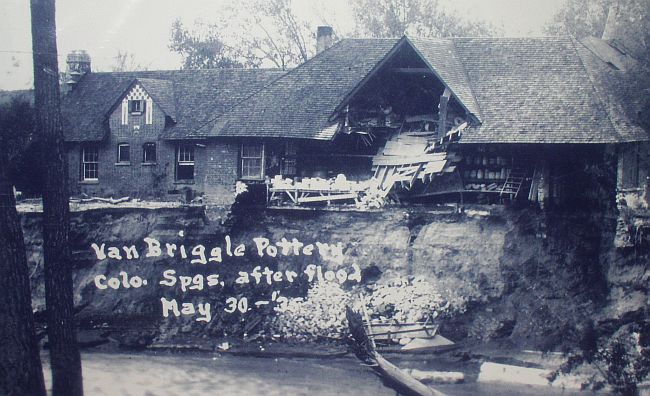
On May 30, 1935, flooding along Fountain Creek caused part of the Memorial Plant building to collapse into the swollen waterway. The disaster carried away not just masonry and equipment but a significant number of pottery molds — the plaster forms used to shape production pieces. Along with the molds, irreplaceable company records were lost to the floodwaters. This single event destroyed a portion of the pottery's institutional memory that can never be recovered, and it is one of the reasons that certain questions about early Van Briggle production may never be fully answered.
3. Catalogs
Van Briggle's printed catalogs are among the most important documents in the collector's reference library. They record what the pottery was producing at specific points in time, complete with shape numbers, descriptions, and sometimes prices. Surviving examples are rare, and even partial pages yield valuable information.
Circa 1903
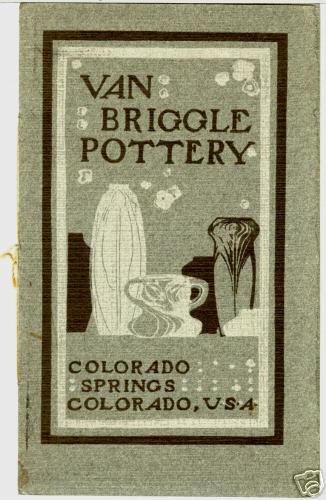
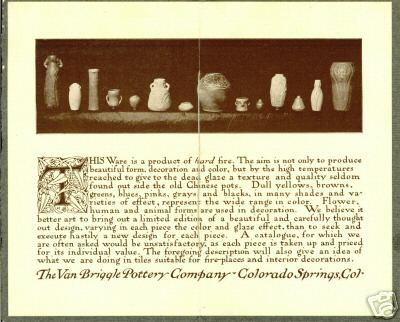
Earliest known Van Briggle catalog. Both the cover and interior pages survive from what is believed to be the pottery's first printed catalog. The cover design reflects the Art Nouveau aesthetic that defined the pottery's identity. Interior pages show drawings and descriptions of available wares, providing a snapshot of the full production line during Artus's lifetime. These pages are the closest thing we have to a complete inventory of early Van Briggle forms.
1908
Interior catalog pages. Pages from a 1908 catalog document the expanded production under Anne Van Briggle's leadership, after the move to the Memorial Plant. New forms appear alongside earlier designs, and the catalog format has become more structured — reflecting the pottery's growth into a more organized commercial operation.
1920s
Multiple catalog pages. Several pages from 1920s-era catalogs have been documented. By this decade, the catalog had evolved into a more polished marketing tool, with better printing and more detailed descriptions. These pages show the full breadth of the pottery's offerings during one of its most productive periods.
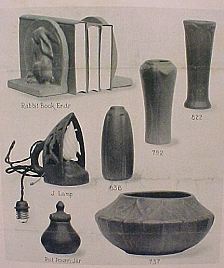
These catalogs are invaluable for identifying shape numbers and understanding what was in production during each era. If you find a shape number on the bottom of a piece, cross-referencing it against surviving catalog pages can confirm the form's identity and approximate date of introduction. Original catalog pages occasionally appear at auction and in estate sales — they are worth acquiring whenever the opportunity arises.
4. Advertisements & Postcards
From its earliest years, Van Briggle promoted itself through print advertising and postcards. These pieces trace the pottery's shifting public identity: from an exclusive art pottery studio to a beloved tourist destination. Each item reflects the marketing language and visual style of its era.
Late 1904
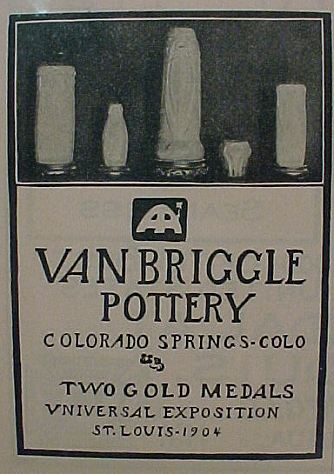
Very early advertisement. One of the earliest known Van Briggle advertisements, dating to late 1904 — the year of Artus's death. The language and design are restrained and dignified, positioning the pottery as a fine art enterprise rather than a commercial manufacturer. At this stage, the audience was connoisseurs and collectors, not tourists.
1914
Promotional postcard. A 1914-era postcard showing the pottery and its wares. By this time, the pottery was beginning to reach a broader audience. The postcard format was a natural fit for Colorado Springs, already establishing itself as a destination for health seekers and tourists.
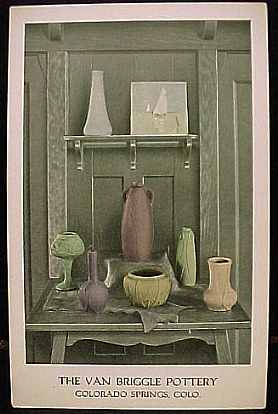
1915
Print advertisement. A 1915 advertisement that reflects the pottery's growing confidence as a commercial operation. The design has evolved from the earliest ads, with bolder typography and more prominent imagery. This was the Ned Curtis era, and the advertising reflects his focus on expanding the market for Van Briggle wares.
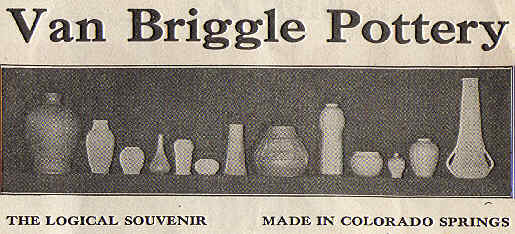
1930s–1940s
Advertising postcard. A postcard from the Depression and wartime era, when the pottery was adapting to changing economic conditions. The messaging had shifted toward affordability and giftability, reflecting the broader market realities of the period.
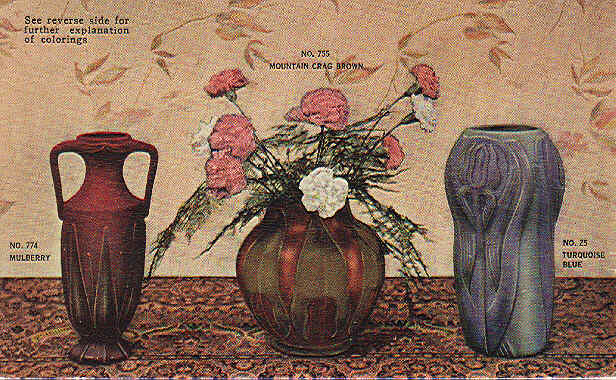
1960s
Postcard featuring Fred Wills at the wheel. By the 1960s, the pottery's advertising had become thoroughly oriented toward tourism. This postcard shows master potter Fred Wills at the demonstration wheel, the kind of image that made Van Briggle a must-see stop for visitors to Colorado Springs. The human element — a skilled craftsman at work — was the pottery's most compelling selling point.
Undated
General advertising postcards. A number of undated postcards survive, showing the pottery building, representative pieces, and the characteristic Van Briggle branding. These were staples of the tourist trade — available at the pottery itself, at hotels, and at rest stops along the highways leading into Colorado Springs.
5. Exhibits & Events
Van Briggle pottery appeared in exhibitions and public installations from its earliest years. These events not only elevated the pottery's reputation but generated photographs and documents that survive as part of the historical record.
1904 World's Fair, St. Louis
The Louisiana Purchase Exposition of 1904 was Van Briggle's greatest early triumph. A display photograph survives showing the pottery's exhibit at the fair — an arrangement of vases and decorative pieces presented to an international audience. The pottery was awarded a gold medal, one of the highest honors available, recognizing the quality of Artus's glaze work and the artistic merit of the forms.
Artus Van Briggle did not live to see the award; he died in July 1904, months before the fair's close. The gold medal certificate survives and is documented separately in the Documents & Certificates section below.
Colorado Springs Masonic Hall, circa 1910
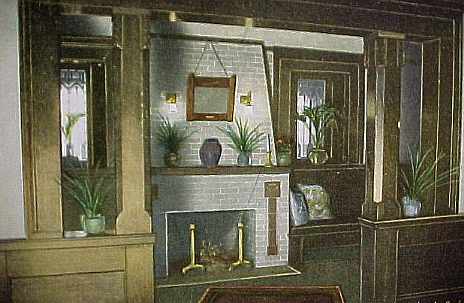
An interior photograph of the Colorado Springs Masonic Hall from approximately 1910 shows a Van Briggle fireplace installed in the building. Van Briggle produced architectural tiles and fireplace surrounds during this period, and the Masonic Hall installation is one of the best-documented examples. The photograph shows the fireplace in its original setting, with the characteristic Van Briggle matte glazes visible on the tile surfaces. These architectural commissions represent a side of Van Briggle's production that is often overlooked in favor of the more familiar vases and bowls.
6. Documents & Certificates
The paper trail of a pottery company includes more than catalogs and advertisements. Stock certificates, award documents, and corporate ephemera round out the picture of Van Briggle as a business enterprise as well as an artistic one.
1902 Stock Certificate
An original stock certificate from the Van Briggle Pottery Company, dated 1902 and issued to William S. Stratton for 5 shares. The certificate bears the signature of Artus Van Briggle himself. Stratton, who had made his fortune in the Cripple Creek gold mines, was a critical early investor whose financial support helped the pottery survive its fragile first years. This document connects two of Colorado Springs' most notable historical figures and two of its most important industries: mining and art pottery.
1904 Gold Medal Certificate
The certificate accompanying the gold medal awarded to Van Briggle Pottery at the 1904 Louisiana Purchase Exposition in St. Louis. This was the highest honor the pottery received during Artus's lifetime (though he did not live to see it awarded). The certificate is a formal, engraved document in the style of early twentieth-century exposition awards — ornate and official, a testament to the international recognition that Van Briggle achieved in just a few years of production.
Early Van Briggle Logo
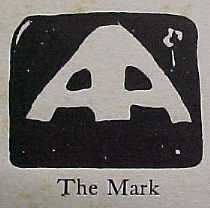
An early version of the Van Briggle logo, preserved from an advertisement. The logo features the conjoined AA monogram — Artus and Anne's intertwined initials — that would become the pottery's most recognizable mark. Studying the evolution of this logo across different printed materials helps document how the pottery's visual identity developed over time. The earliest versions show a more fluid, hand-drawn quality; later versions become progressively more standardized.
7. Other Historical Items
Beyond photographs and printed materials, the Van Briggle archive includes a variety of objects and images that do not fit neatly into the categories above but are no less important for understanding the pottery's full history.
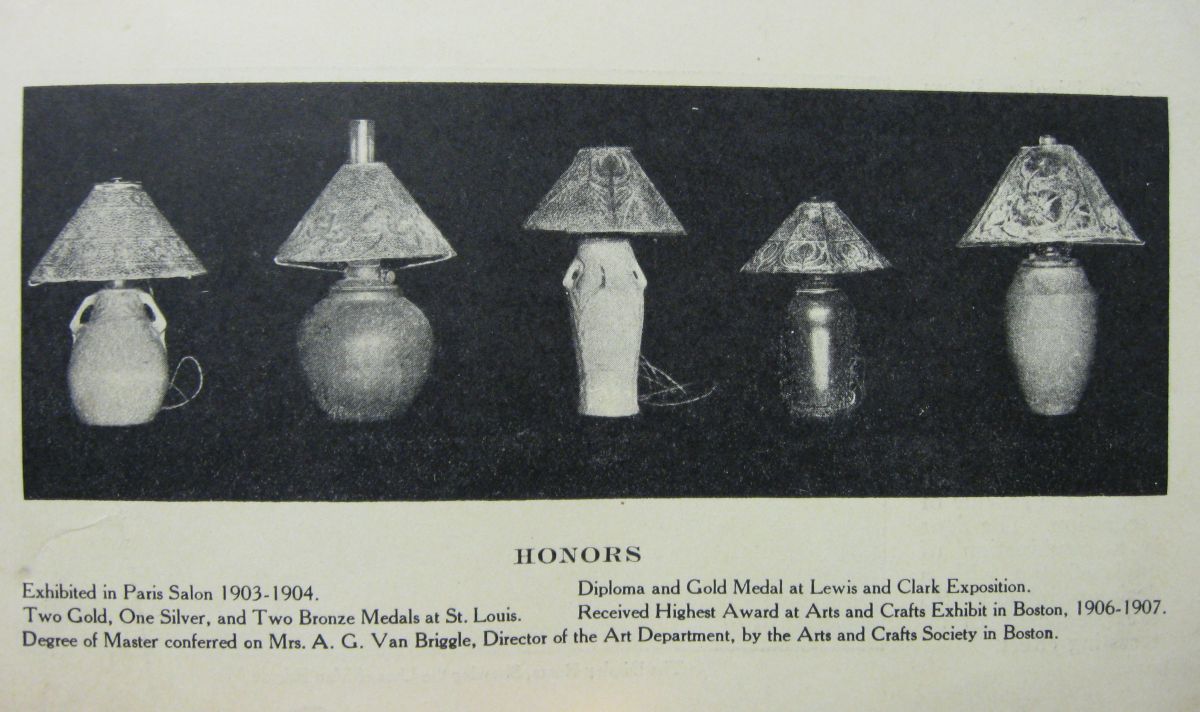
Early Van Briggle lamps with brass shades. Photographs document Van Briggle's early production of lamp bases, fitted with ornate brass shades in the Art Nouveau style. These lamps represent a functional application of Van Briggle's artistic glazes and forms. They are rare today and highly sought after by collectors of both pottery and early twentieth-century lighting.
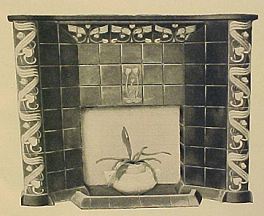
Early fireplace photographs. Close-up views of a Van Briggle fireplace in what appears to be a sales office or showroom setting. The photographs show the detail of the tile work and the integration of Van Briggle's characteristic matte glazes into an architectural context. These images demonstrate that Van Briggle's ambitions extended well beyond tabletop pottery into the decorative arts of the built environment.
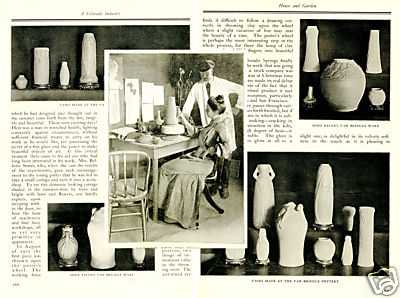
Early feature article. A published article about the pottery, dating to the early years of operation. Feature articles in newspapers and magazines were an important form of publicity for art potteries in the early twentieth century, and Van Briggle's story — the young artist's struggle with tuberculosis, the move to Colorado, the quest for the dead matte glaze — was inherently compelling. These articles shaped public perception of the pottery for decades.
Brochure holders. Physical brochure holders that were placed at tourist stops, hotels, and rest areas around Colorado Springs. These modest objects are a tangible reminder of the pottery's long career as a tourist attraction — the kind of roadside Americana that defined mid-century travel in the American West. A brochure holder with its original Van Briggle brochures intact is a small piece of marketing history.
Ephemera items — original catalogs, advertisements, factory photographs, stock certificates, and postcards — are collectible in their own right and can command significant prices at auction. But their value extends beyond the market. They serve as invaluable research tools for dating and identifying pottery pieces. A catalog page showing a specific shape number confirms that the form was in production during that era. A factory photograph showing shelves of drying ware can reveal forms and glazes that are otherwise undocumented. If you encounter Van Briggle ephemera in the wild, consider acquiring it — even a single catalog page or postcard can fill a gap in the historical record.
Further Resources
- Markings & Identification Guide — High-resolution reference photos of Van Briggle bottom marks from 1901 to 2004, including museum-quality images from the Metropolitan Museum of Art.
- Dating Van Briggle Pottery — A complete era-by-era guide to dating Van Briggle pieces using script style, clay color, bottom condition, and marking characteristics.
- Novelties & Souvenir Pieces — Guide to Van Briggle's novelty and souvenir production, including tourist-era items and special commissions.
- Gallery — Photographs of Van Briggle pottery pieces from our collection and public domain museum sources.
- About Van Briggle Pottery — The full history of Van Briggle Pottery, from Artus's arrival in Colorado Springs to the pottery's legacy today.