For a pottery that operated out of Colorado Springs, Van Briggle has an extraordinary museum presence. Pieces sit in permanent collections on both sides of the Atlantic, from New York to London to Denver. If you’re a collector, visiting these collections is one of the best ways to train your eye — you’ll see early glazes, original forms, and maker’s marks up close in ways that photographs can’t replicate.
Here’s where to find Van Briggle in museums, what they hold, and what collectors can learn from each.
Colorado Springs Pioneers Museum — The Definitive Collection
If you’re serious about Van Briggle, this is where you start. The Pioneers Museum holds over 700 pieces — the largest Van Briggle collection in existence. More than 150 are on permanent exhibit in their show “From Paris to the Plains: The Artistry of Artus & Anne Van Briggle.”
The foundation of this collection came from the 1904 Louisiana Purchase Exposition in St. Louis, where Van Briggle won two gold, one silver, and two bronze medals. The El Paso County Commissioners had underwritten shipping costs for the exhibition pieces, and after they returned to Colorado Springs, they were donated to the museum. Later, collector Lois Crouch donated over 225 additional pieces — she’d spent decades documenting and studying the pottery and was named a “living treasure” by the Colorado Springs Fine Arts Center in 1992.
All 700-plus pieces are now stored together in a dedicated vault completed in 2019. The museum is at 215 South Tejon Street in downtown Colorado Springs. Free admission. Open Tuesday through Saturday, 10am to 5pm.
You can search their collection online at cspm.pastperfectonline.com.
The Metropolitan Museum of Art — New York
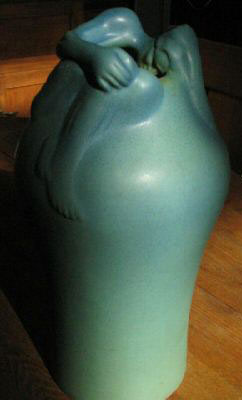
The Met holds approximately 31 Van Briggle pieces spanning 1901 to the 1920s, including some of the most important early works in existence. Their collection includes the Despondency vase, the Lorelei, the Mistletoe vase with copper mounts, Peacock Feathers, Daffodils, and many more — all from the hand of Artus Van Briggle himself.
What makes the Met collection especially valuable to collectors is the two distinct donations. The Eidelberg Collection features pieces attributed directly to Artus, while the Ellison Collection includes detailed photographs of maker’s marks on each piece — an invaluable reference for anyone trying to date and authenticate their own Van Briggle pottery.
We’ve written a detailed article on the Met’s Van Briggle collection with photographs of every public domain piece and their marks.
You can browse the full collection at metmuseum.org.
Smithsonian Institution — Washington, D.C.
The Smithsonian’s National Museum of American History holds Van Briggle in its Ceramics and Glass collection. Two documented pieces include a 1905 monochrome blue-green earthenware vase with relief long-stemmed leaves (7 1/4 inches tall) and a monochrome blue ceramic vase (8 1/8 inches). Neither is currently on display, but both are documented in the online database.
The full Ceramics and Glass collection contains over 35,000 pieces, so there may be additional Van Briggle works beyond what’s catalogued online. The Smithsonian also features Van Briggle in its American Art Pottery spotlight.
Search their collection at americanhistory.si.edu/collections — enter “Van Briggle.”
Victoria and Albert Museum — London
The V&A holds two confirmed Van Briggle pieces, both currently on display at V&A South Kensington. One is a Lorelei vase originally modeled by Artus, produced between 1920 and 1930. The second is a vase from approximately 1920-1929.
You’ll sometimes see claims that the British Museum holds Van Briggle. That claim is widely repeated — including on the official vanbriggle.com website — but it may be a conflation with the V&A. Both are major London museums, and the V&A’s holdings are confirmed and documented online while the British Museum’s are not.
Browse the V&A’s Van Briggle pieces at collections.vam.ac.uk.
Kirkland Museum / Denver Art Museum — Denver
The Kirkland Museum holds Van Briggle pieces including a Despondency vase (designed 1900, this example produced 1915). There’s a personal connection here: when Kirkland Museum founder Vance Kirkland arrived in Colorado Springs in 1929, Anne Van Briggle herself introduced him to the pottery’s work shortly before her death that same year. He became one of the earliest serious Van Briggle collectors.
The Kirkland collection is now part of the Denver Art Museum. Located at 1201 Bannock Street in Denver’s Golden Triangle Creative District.
Manitou Springs Heritage Museum — Manitou Springs, CO
Just a few miles from the original pottery, this small museum features “Van Briggle: The Manitou Connection” — more than 100 pieces, most original and hand-thrown. The oldest piece on display dates to 1906, and over ten pieces span from 1906 through the 1920s. You’ll also find unusual items like a 75th anniversary piece (only 500 made) and a 100th anniversary piece.
Free admission. Open seven days a week, noon to 4pm, at 517 Manitou Avenue.
Brooklyn Museum — New York
The Brooklyn Museum holds at least two documented pieces: a Lorelei vase from circa 1925 (earthenware, 9 1/2 inches tall, with beehive-in-rectangle mark) and a vase from circa 1922-1929 with the incised beehive double-A mark.
Search at brooklynmuseum.org/opencollection — enter “Van Briggle.”
Museum of the American Arts & Crafts Movement — St. Petersburg, FL
The world’s only museum dedicated exclusively to the American Arts and Crafts movement, founded by collector Rudy Ciccarello. Van Briggle pottery sits alongside Grueby, Rookwood, Newcomb, and Teco in their ceramics collection. Their parent organization, the Two Red Roses Foundation, purchased a rare 1902 Lorelei vase at auction for $275,000 — a record for Van Briggle at the time.
The Louvre — Paris
The story goes that Artus Van Briggle’s Despondency vase won first place at the 1903 Paris Salon and was purchased by the Louvre for $3,000 — an extraordinary sum at the time. This claim has been repeated for over a century in virtually every Van Briggle history, and it’s a compelling part of the pottery’s story.
What collectors should know: this purchase has never been independently verified through Louvre records. The dates, the specific piece, and the price vary across sources. It’s deeply embedded in Van Briggle lore, and it may well be true — Artus did study in Paris, his work was exhibited at the Salon, and it did win major awards. But treat it as unconfirmed tradition rather than documented fact.
Colorado Springs Fine Arts Center
The Fine Arts Center has held Van Briggle exhibitions since the 1970s, including a major 1975 retrospective that displayed more than 300 examples of early pottery. They published Van Briggle Pottery: The Early Years, a key reference work. More recently, their “Van Briggle Unveiled” event featured rarely seen ceramics from their collection.
What Collectors Can Learn from Museum Visits
Seeing Van Briggle in person — especially early pieces from 1900 to 1912 — teaches you things that no book or website can. The depth and variation of the matte glazes, the crispness of the relief modeling on early molds versus later worn ones, the weight and feel of the clay body, the subtle differences between a 1902 mark and a 1920s mark. If you’re near any of these museums, it’s worth the trip.
For more on identifying and dating your own Van Briggle pieces, see our Markings & Identification Guide.
Books for Museum-Goers and Collectors
Visiting museums is better with context. These references will deepen what you see:
- The Collector’s Encyclopedia of Van Briggle Art Pottery — the essential identification guide, helpful for comparing your pieces to museum examples.
- The Story Behind the Clay — covers Van Briggle’s specialty and commissioned pieces, many of which appear in museum collections.
- Kovels’ American Art Pottery — context for understanding Van Briggle alongside Rookwood, Grueby, and other potteries you’ll see in these museums.