Van Briggle Blue Vases: Ming Blue, Turquoise & Other Blues
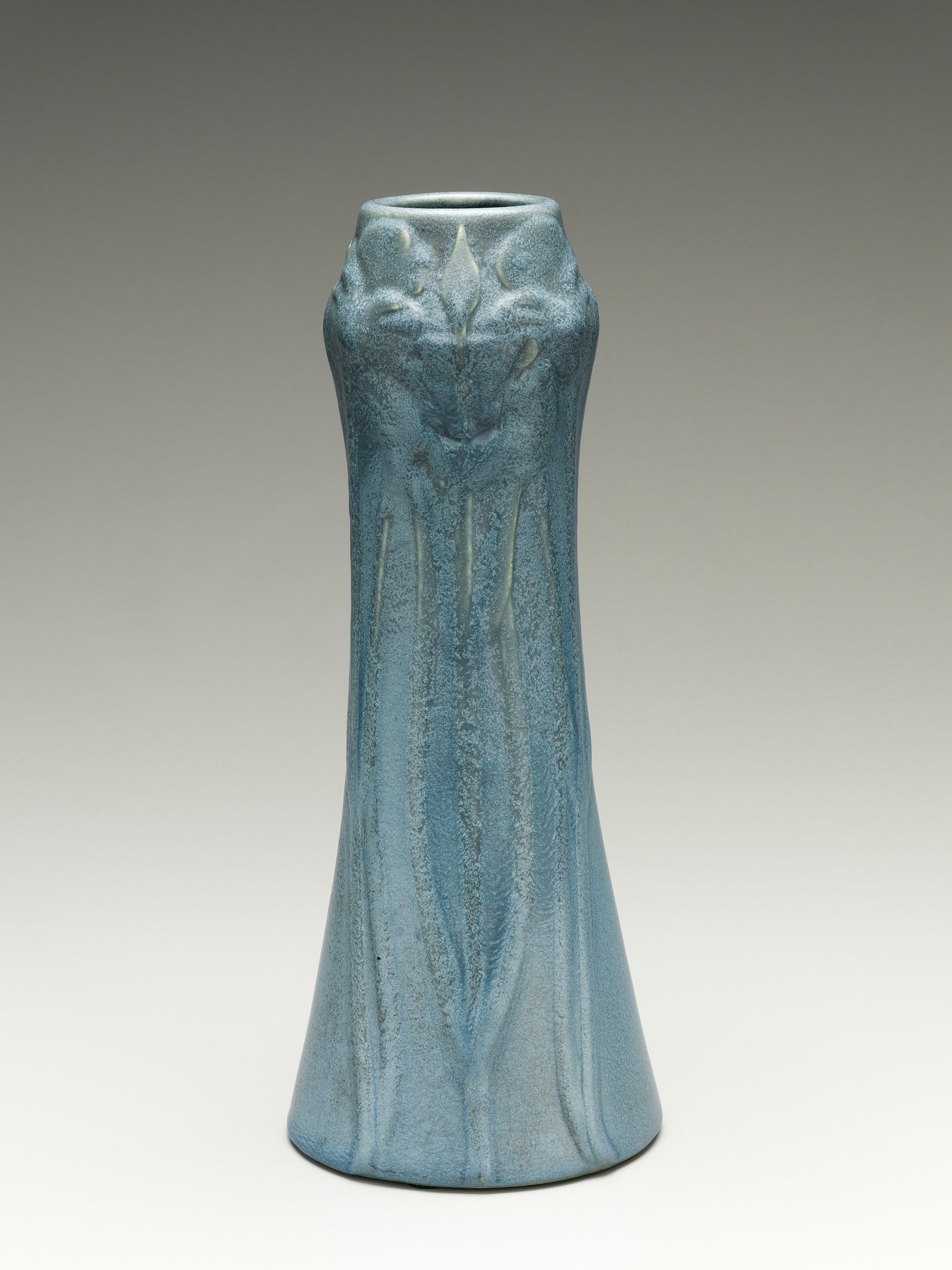
Most blue Van Briggle is Turquoise Ming, the pottery’s signature glaze. Collectors and auction houses usually call it Ming Blue; it has also been sold as Ming Turquoise, Ming, and Blue-Green, and all of those are the same glaze family. In 1969 it was one of only two matte glazes still in production and about 30 percent of everything the pottery made, so a blue Van Briggle vase can come from almost any decade between 1902 and 2012.
The way the blue was applied changed over that century, and that is what dates a blue vase once you have checked the bottom. Values run from about $275 for a mid-century vase to $43,750 for a 1902 Lorelei in pale blue.
The Van Briggle Blues
Turquoise Ming (Ming Blue)
Jeff Stevenson, who ran glaze development at the pottery from 1977 to 1988, describes Turquoise Ming as two glazes: a turquoise base, applied by dipping and then spraying, and a darker blue “mottling” sprayed over it. That second coat is the dark blue you see gathered on the high points or the rim of a Ming Blue piece. Family legend says Artus Van Briggle modeled the glaze on Ming Dynasty pottery he saw in European museums. Some early company material repeats the story, and at least one recent researcher has doubted it.
Early Blues (1902–1912)
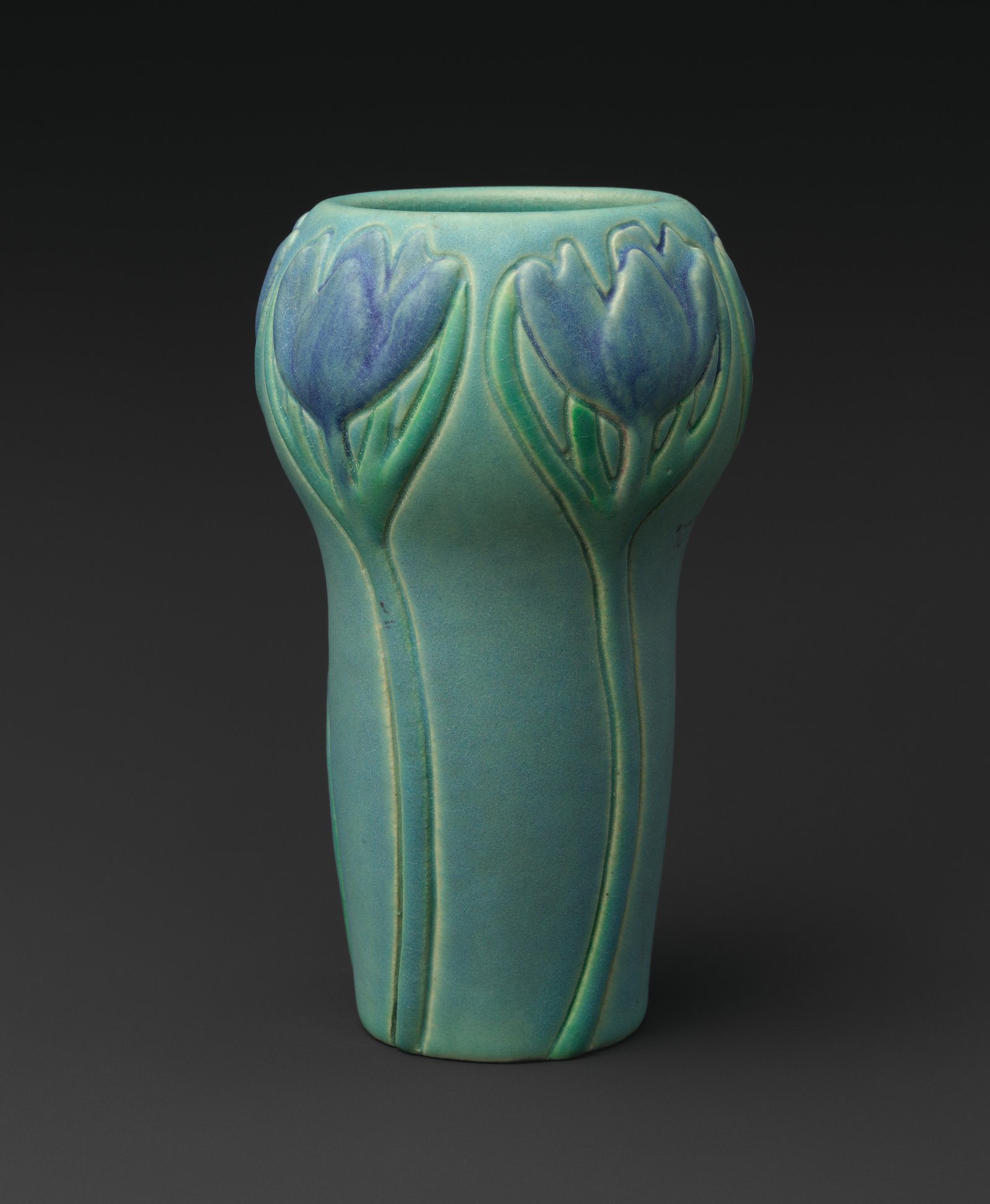
The earliest known Van Briggle color list, believed to date from before 1913, names five blues: light, turquoise, medium, dark, and navy. Blue pieces survive from 1902 onward, including the Met’s 1902 crocus vase and its 1903 vase pictured above. On pieces from 1905 to 1907 made with a darker “chocolate” clay, a thin blue glaze lets the brown clay show through on the high points of the design. Copenhagen Blue appears as early as 1903 and was reintroduced in 1916, when a Vogue advertisement featured it.
Later Blues (1980s–2012)
- Cobalt Blue: a gloss introduced in spring 1982 and a matte version developed in the 1980s.
- Iceberg (1983–1988) and Moonglo Mist (1987–1988): whites with blue tint or blue highlights, often listed for sale as blue.
- Lilac Blue: introduced in November 1993 according to vanbrigglenotes.com; some sources give 1999.
- Deep Sea (2000): a reformulation of the early Copenhagen-type blue, made for the centennial reproduction of the Lorelei.
- Roundhouse Blue (2010): a speckled matte denim blue made from spray-booth dust found during the 2008 move out of the roundhouse, used in limited production on butterfly bowls, dragonflies, and rabbits.
A shiny black piece with a blue-white drip is not a blue glaze at all. Late gloss black was topped with a white overglaze that turns bluish where it meets the black. Our Glaze Reference has swatches for many of these.
How to Date a Blue Van Briggle Vase
Look first at where the dark blue sits. The pattern below follows the glaze timeline published by clemhull.com, the collector site our glaze swatches come from.
| Era | What the Ming Blue looks like |
|---|---|
| Teens | Uneven, with small imperfections; late teens pieces can be thin and almost translucent with darker blue and mulberry highlights. |
| 1920s | Heavy dark blue overspray, then highlights that follow the relief design closely. Glaze often streaks onto the bottom. |
| After 1926 | More standardized, with subtler highlighting. |
| 1930s–1940s | Dark overspray at the top, Ming Blue in the middle, fading almost to bare clay toward the foot. |
| 1940s–1960s | Very like the late 1920s. Tell them apart by clay, marks, and heavier crazing on the older piece. |
| 1970s–1980s | Often a single heavy coat with little or no dark overspray. |
| 1990s | Only a hint of the dark blue overspray. |
Then turn it over:
- Clay: fine white clay means the 1930s through 1969. Buff clay means either the 1920s to early 1930s or 1970 and later, so it needs the marks to settle it. See Clay Body History.
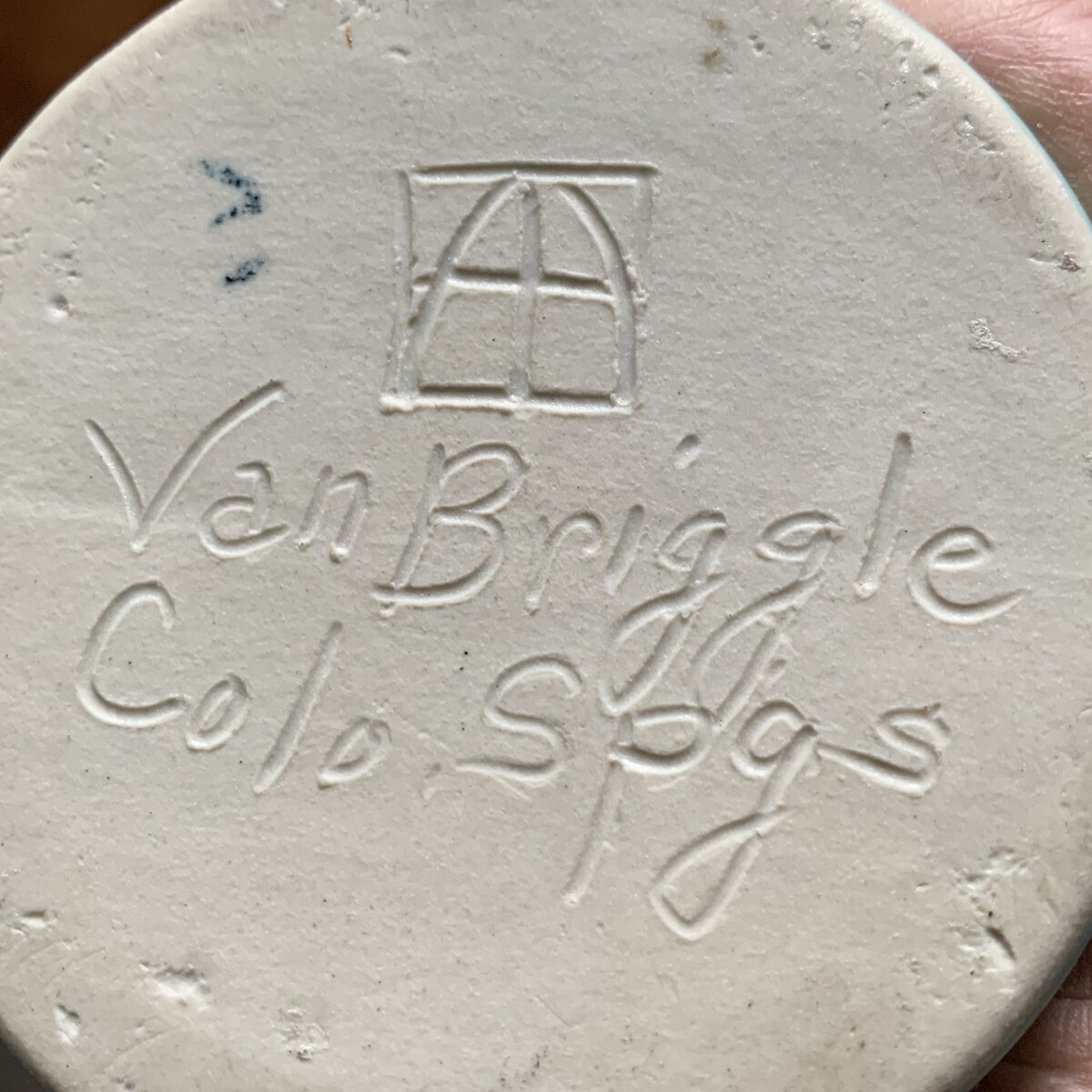
- Marks: a date on the bottom means 1907 or earlier; “USA” points to the 1920s; letter-and-digit codes such as V5 or A1 mean 2000 or later. The dating guide has the full sequence.
- “Anna Van Briggle”: from the mid-1950s to 1969 that script mark went on the gloss line made at the 21st Street plant. A matte Ming Blue piece from those years should carry the regular “Van Briggle” mark.
What Blue Van Briggle Vases Sell For
These ranges come from Rago, Toomey & Co., Cottone, and Leland Little results between 2017 and 2026.
| Era | Typical Sold Price | Notes |
|---|---|---|
| 1902–1904 floral vases | $1,250–$5,300 | A large 1903 water lily vase brought $5,313; a 1902 Lorelei in pale blue matte sold for $43,750 in 2017. |
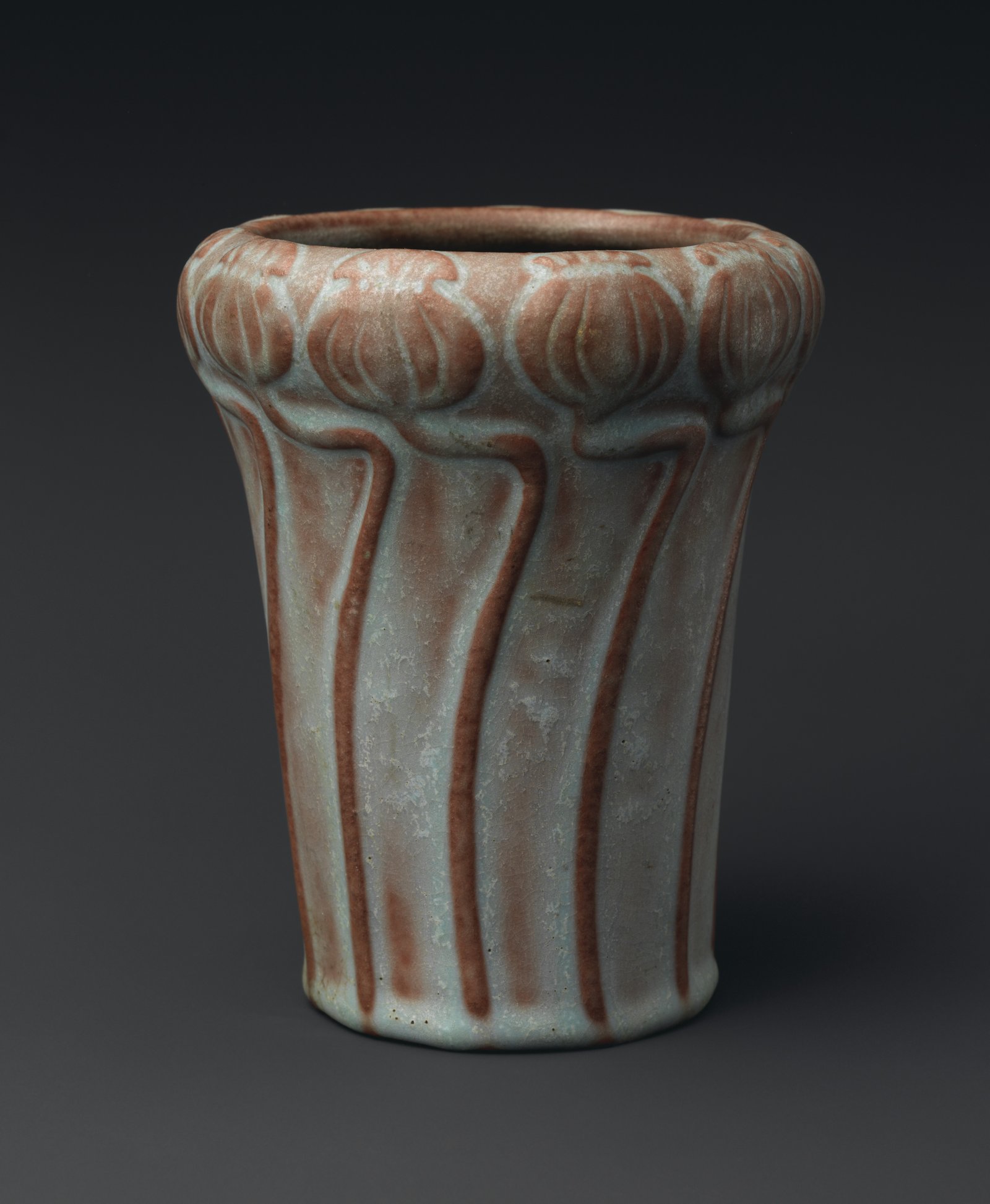
| 1905–1912 | $900–$2,800 | A 1912 poppy pod vase with darker overspray made $2,794 in 2026. |
| Teens & 1920s | $300–$600 | Tulip and coneflower vases. Rare forms go far higher: a 1920s Ming Blue mermaid toast cup sold for $3,432. |
| 1930s–1960s | $275–$950 | Few recorded sales. A 10-inch turquoise tulip vase with crazing brought $275; a Lady of the Lily from about 1935, $953. |
| Late turquoise floor figurals | $438–$660 | A 16½-inch Despondency from about 1990 and an 18-inch Three Graces vase. |
Small late Ming Blue vases rarely go to auction on their own, so we have no reliable sold range for them; they sell for modest amounts at estate sales and online. For small pieces, see our bud vase guide, and for all eras, our Van Briggle value guide.
Frequently Asked Questions
Is Ming Blue the same as Turquoise Ming?
Yes. Turquoise Ming was the factory name; Ming Blue, Ming Turquoise, Ming, and Blue-Green are other names for the same glaze.
Is my blue vase old?
Check the clay and marks first, then compare the dark blue overspray with the table above. White clay with a regular “Van Briggle” mark is 1930s to 1969; a dated bottom is 1907 or earlier.
Which blue forms are most common?
Tulip vases, Lorelei and Despondency reproductions, the Three Graces, calla lily and rolled-leaf vases, bowls with flower frogs, and small bud vases all turn up regularly in Ming Blue.
Related Buying Guides
Explore our other Van Briggle buying guides for specific forms and the complete buying resource.
Complete Buying Guide
Where to buy, what to look for, values by era, and tips for building a collection.
← Back to guideLorelei Vase
Van Briggle’s most iconic design, the siren draped over the vessel rim. History, values, and where to find one.
Buying guide →Flower Frog
Scarab, fly, and snail figurals plus standard production. Some of Van Briggle’s most charming small pieces.
Buying guide →Tulip Vase
One of the most recognizable Van Briggle forms, produced across every era of the pottery’s history.
Buying guide →Bud Vase
Elegant small vases in Van Briggle’s signature matte glazes. Perfect starter pieces for new collectors.
Buying guide →Pitcher
Utilitarian pieces with Van Briggle’s Art Nouveau styling. Found across all eras of production.
Buying guide →Bookends
Early collectible bears, wolves, and owls plus late commercial squirrels, eagles, dolphins, and conquistadors.
Buying guide →Mulberry Vases
The deep red-purple used until 1946, and how to tell it from Persian Rose and later roses.
Buying guide →Lamps
Brass-shade art lamps, mid-century figurals with butterfly shades, and converted vases. How to tell them apart and what they sell for.
Buying guide →Animal Figurines
Kinkead’s 1916 bunny, mid-century elephants and donkeys, tall standing cats, and the Chimney Cat.
Buying guide →Bowls
Dragonfly bowls and their three-frog frogs, Siren of the Sea and Lady of the Lake centerpieces, console and rose bowls.
Buying guide →Candle Holders
From J. Emma Kinkead’s 1911 lizard candlestick to mid-century tulip pairs. Designs, marks, and sold prices.
Buying guide →Indian Maiden & Indian Head
The three-face “Indian Head” vase, corn grinder figures, and the “Little Star” plaque.
Buying guide →Reference Books
Price guides, marks references, and histories for Van Briggle and the major American art potteries.
Browse the books →