Van Briggle Bookends: History, Value & Identification
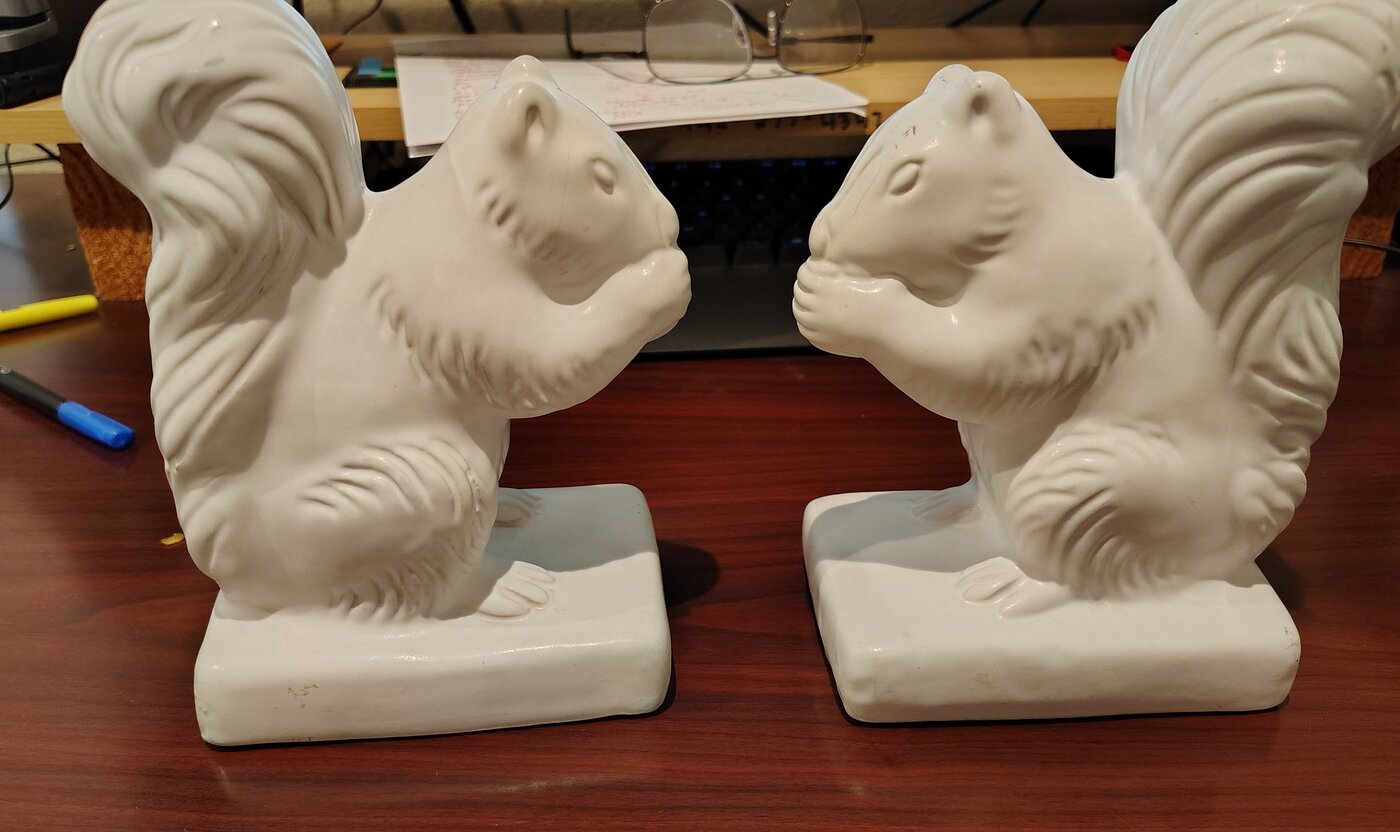
Van Briggle produced bookends across more than a century of operation, and they fall into two very different categories with very different values. The early bookends from the 1910s through the 1930s — bears, wolves, owls, and assorted figural pairs — are scarce collectibles that command serious prices. The late commercial bookends from the 1970s through the 1990s — squirrels, eagles, dolphins, conquistadors, horses — were produced in far larger numbers and trade in a much more accessible price range.
Whichever you have, the same identification fundamentals apply: read the bottom marks, check the clay color, and assess the glaze. This guide walks through both eras, what each looks like, what each is worth, and where to find or sell them.
History & Designs
Van Briggle bookends span the full arc of the pottery’s production. Heavy, sculptural, and built to anchor a row of books, they were one of the more substantial novelty forms the company made. The subjects shift dramatically from one era to the next, reflecting changes in ownership, market preferences, and production economics.
Early Era Bookends (1910s–1930s)
The early bookends drew from Rocky Mountain wildlife and Art Nouveau sensibilities. Bears in an unusual mustard yellow with mulberry overspray (1922–1926, marked USA), wolves rendered in matte glazes (1915 era), and stylized owls in the early production palette are the most documented forms. These were never made in great quantities, and survival rates over a century have made matching pairs particularly hard to come by. For the full early-era catalog with reference photos, see our Novelties guide’s bookend section.
Late Commercial Bookends (1970s–1990s)
From the 1970s onward, Van Briggle produced bookends in a different mode: commercial quantities, standardized forms, and a glossy white Moonglo glaze that defines the era visually. The same buff (beige) clay body that the pottery adopted in 1970 is visible on the unglazed bottoms of every late commercial bookend. Several figural subjects recur:
- Squirrel bookends are the most commonly encountered late commercial form. Each squirrel sits upright on a rectangular base, holding a nut in its forepaws, with the bushy tail curving up behind. Typically about seven inches tall.
- Eagle bookends show the bird with wings folded, perched on a base. A patriotic subject that appealed to the late-twentieth-century gift market.
- Dolphin bookends render the animal mid-leap, often with stylized waves at the base. A more decorative, less sculptural subject than the early animals.
- Conquistador head bookends depict a helmeted Spanish conquistador in profile, drawing on the Southwestern historical themes the pottery explored throughout its later years.
- Horse and horse-head bookends appear in several variants. These tend to have heavier modeling and slightly larger bases than the squirrel pairs.
All of these share the same construction (slip-cast on buff clay), the same glaze family (Moonglo, with the brighter post-1979 reformulation appearing on the cleanest examples), and the same marking conventions. The visual differences come down to the figural subject and sometimes the glaze color, with greens, browns, and Persian Rose appearing alongside the dominant white.
Identifying Authentic Bookends
The single most useful diagnostic for any Van Briggle bookend is the unglazed clay visible on the bottom. The pottery switched its clay body from white to buff (beige) in 1970, and that change is one of the most reliable dating tools we have. White clay means pre-1970, buff clay means 1970 or later. Our Clay Body History page covers the full timeline.
Beyond the clay, look for these features on late commercial bookends:
- Cursive incised “Van Briggle” on the bottom plus a second cursive signature on the back of each base.
- “Colo Spgs” abbreviation for Colorado Springs, also incised.
- Two-letter finisher initials near the signature. Cross-reference these against the Finisher Marks directory to identify the specific worker when known.
- Optional studio stamp shaped like a small window or cottage, observed on some 1980s and 1990s pieces. Not universal but a useful era confirmation when present.
- Glossy white Moonglo glaze as the most common finish. Brighter, cleaner whites generally indicate post-1979 reformulation; slightly grayer whites can be earlier. See the Moonglo section of the Glaze Reference for era-by-era differences.
Authentication tip: A 10x triplet loupe is genuinely useful for reading two-letter finisher initials, which are sometimes shallow or partially worn. Holding the bottom up to a side-lit lamp also helps the incised marks read clearly.
Early era bookends carry the conjoined “AA” monogram and other markings consistent with their decade of production. The Markings & Identification Guide and Dating Your Pottery page walk through the era-by-era differences in detail.
Current Market Value
Bookend values vary dramatically across eras and forms. Early collectible bookends and late commercial bookends are essentially two different markets, and a buyer who paid a premium expecting an early piece can be disappointed to learn they have a late commercial form. The following ranges reflect typical recent sales.
| Type | Price Range (Pair) | Notes |
|---|---|---|
| Early Era Pairs (1910s–1930s) | $400–$1,500+ | Bears with documented USA mark, wolves, and early owls. Matching pairs in original glazes command the highest prices. |
| Early Era Singles (orphaned) | $100–$400 | A single from a separated pair is worth significantly less than half of the pair price; matching pairs are what collectors pay for. |
| Late Commercial Squirrel Bookends | $40–$150 | Glossy white Moonglo on buff clay, 1980s–1990s. Clean condition with both pieces of the pair brings the higher end. |
| Late Commercial Eagle / Dolphin / Conquistador Bookends | $50–$200 | Slightly higher than squirrels on average; the Spanish conquistador heads in particular have a small dedicated collector market. |
| Late Commercial Horse / Horse-head Bookends | $60–$200 | Heavier modeling and equestrian crossover appeal can lift these above the typical late commercial range. |
| Late Commercial Singles (any form) | $20–$60 | Orphaned late bookends. Functional and decorative but lose most of their value when separated from the pair. |
Set realistic expectations: If you own late commercial bookends and the family story says they are valuable antiques, the buff clay on the bottom tells the real story. They are authentic Van Briggle, decorative, and worth modest two-figure to low three-figure money. They are not the early matte-glaze rarities that make auction headlines.
Where to Find Bookends
eBay
eBay carries late commercial bookends almost continuously, with squirrel pairs appearing most often. Set up saved searches for “Van Briggle bookends” plus your specific form of interest (“Van Briggle squirrel bookends,” “Van Briggle conquistador,” and so on). Always check the “Sold Items” filter to gauge actual market values rather than asking prices, which tend to run high.
Estate Sales & Antique Shops
Estate sales are the best source for late commercial bookends in good condition. The twentieth-century homeowners who originally bought these pieces are now the demographic whose estates are being liquidated, so squirrel and eagle pairs turn up regularly. Antique shops in Colorado and the Mountain West have an outsized presence, given Van Briggle’s Colorado Springs origins.
Auction Houses
Early era bookend pairs in good condition are best sourced through specialist auction houses (Rago, Toomey, Cottone) where they will be properly catalogued and authenticated. Late commercial bookends rarely appear at major auctions; they live almost entirely on eBay and in estate-sale circulation.
Photo Gallery


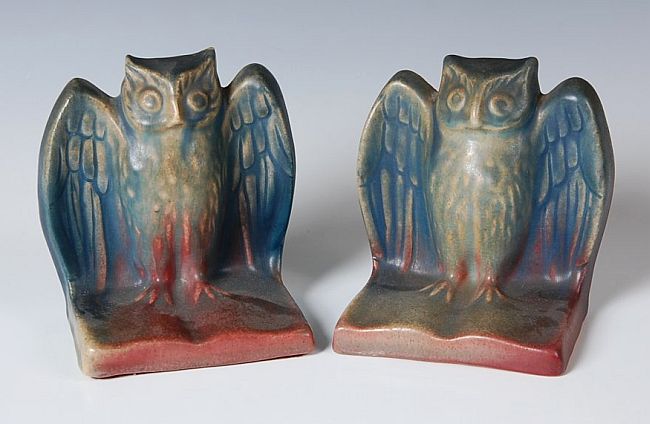
Photo references for eagle, dolphin, conquistador, and horse bookends are being added as collector submissions come in. If you own one of these forms and would like to contribute a reference photo, see our contact page.
Related Buying Guides
Explore our other Van Briggle buying guides for specific forms and the complete buying resource.
Complete Buying Guide
Where to buy, what to look for, values by era, and tips for building a collection.
← Back to guideLorelei Vase
Van Briggle’s most iconic design — the siren draped over the vessel rim. History, values, and where to find one.
Buying guide →Flower Frog
Scarab, fly, and snail figurals plus standard production. Some of Van Briggle’s most charming small pieces.
Buying guide →Tulip Vase
One of the most recognizable Van Briggle forms, produced across every era of the pottery’s history.
Buying guide →Bud Vase
Elegant small vases in Van Briggle’s signature matte glazes. Perfect starter pieces for new collectors.
Buying guide →Pitcher
Utilitarian pieces with Van Briggle’s Art Nouveau styling. Found across all eras of production.
Buying guide →Reference Books
Price guides, marks references, and histories for Van Briggle and the major American art potteries.
Browse the books →