Van Briggle Bowls: Dragonfly, Console & Rose Bowls
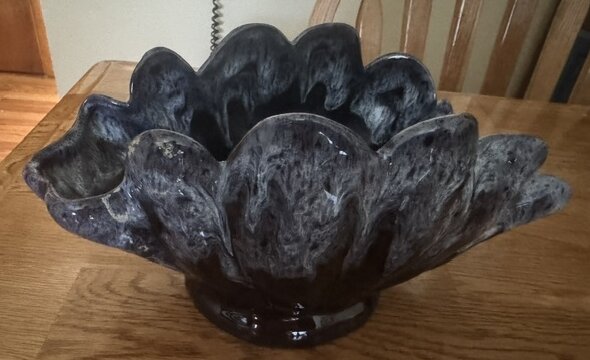
Bowls were one of the pottery’s biggest lines. Kathy Honea’s design catalogue at vanbrigglenotes.com lists about 120 numbered bowl designs from 1901 to 1912 alone, molded with leaves, poppies, mistletoe, pine cones, fish, butterflies, and above all dragonflies. Many of the same molds stayed in production for the next hundred years, so a dragonfly bowl can be a 1906 original worth several hundred dollars or a 1990s piece worth $20.
The bottom of the bowl, and whether it still has its flower frog, decides most of the value.
History & Forms
Early Bowls (1901–1912)
Artus Van Briggle’s own bowls are low and mid-height forms with stylized leaves or flowers around the rim, such as the crocus bowl (#145) and peacock-feather bowl (#146), both 1903. After his death in 1904, Anne Van Briggle and the pottery’s designers produced most of the numbered bowls. Plain shapes are credited to head potter Ambrose Schlegel; the relief-decorated ones came from Anne and designers such as J. Emma Kinkead, whose pine cone bowl (#762) is recorded as a gift to General Palmer at the dedication of the Memorial Pottery in December 1908.
Dragonfly Bowls
According to Kinkead’s records, Anne designed every Van Briggle dragonfly pattern but two. The count of dragonflies and the size help identify the design:
- Three dragonflies: #837 (1910), a small bowl about 4¼ inches across.
- Four: #473 (1906), about 5¼ inches; #903D (8 inches) and #910D (10 inches), both 1912.
- Five: #539 (1906, about 6½ inches), #620 (1907, a low 5¼-inch bowl), and #912D (1912, 12 inches).
The 8-, 10- and 12-inch dragonfly bowls of 1912 were made to take a flower frog of three inward-facing frogs. Small 4-inch dragonfly bowls, often listed as rose bowls, were made in quantity in later decades.
Figural Centerpiece Bowls
- Siren of the Sea (#899, 1911): a 13½-inch bowl with a mermaid reclining on its side, a fish impressed inside the opposite rim, and a conch-shell flower frog. It is generally believed to be Anne’s last design, though that has not been confirmed. Examples on sandy 1920s clay and in later glazes are common.
- Lady of the Lake: a woman leaning over the water, about 15 inches long, with a turtle-on-a-rock or frog-on-a-lily-pad flower frog. Auction houses date examples to the 1920s and 1930s. We have not found a design number for it.
- Auction catalogs also describe a Water Nymph bowl and frog and a maiden-and-swan low bowl, both in the 1930s to 1950s range by the sellers’ estimates.
Console, Rose & Mid-Century Bowls
From the 1930s on, the pottery made tulip, lotus, oak-leaf-and-acorn, leaf, and philodendron bowls, most with a matching flower frog, in Ming Blue, turquoise, Persian Rose, and mulberry, and later in Russet, Aspen Sunrise, and Moonglo on buff clay. Pierced rose bowls and small dragonfly rose bowls run through the late commercial years. The mid-century Anna Van Briggle gloss line added deep petal bowls like the one pictured above and three-bowl sets sold in a metal carrier.
Bowls and frogs were usually sold separately, though some frogs were advertised with a particular bowl, and one design is listed with an “optional flower frog and paperweight.” Today bowls often turn up with a frog and a pair of candlesticks as a console set, but we have found no factory record of candlesticks being sold as part of a set. See our flower frog guide and candle holder guide.
Dating a Van Briggle Bowl
- Dates and design numbers: bowls from 1901 to about 1912 are usually incised with the AA monogram, “Van Briggle,” a date, and often an impressed design number. A letter after the number, as in #903D or #41D, is a size code.
- Glaze on the bottom: a glaze-streaked “dirty bottom” points to the teens. A rough, sandy unglazed bottom points to the late 1920s and early 1930s.
- “USA”: early designs reissued in the 1920s may carry a “USA” mark.
- Clay: white clay means the 1930s through 1969; buff clay means 1970 or later. See Clay Body History.
- Glaze as a date fence: Mountain Crag Brown was made only until the 1935 flood, so a true Mountain Crag bowl is pre-1936. Persian Rose was discontinued before 1969. The Glaze Reference has the rest.
The full timeline of marks is in our dating guide and Van Briggle pottery marks guide.
Current Market Value
These ranges come from auction hammer prices, before buyer’s premium, between 2011 and 2026, for pieces without serious damage.
| Type | Typical Sold Price | Notes |
|---|---|---|
| Dated bowls, 1901–1912 | $300–$1,000 | Most $500–$850. A 1902 matte green bowl brought $800 and a 1906 #467 $850. A mulberry pine cone bowl sold for $850 in 2026. |
| Teens & 1920s dragonfly bowls | $100–$450 | 8–10 inches, with or without the three-frog frog. A matte blue example from about 1915 sold for $375. |
| Figural centerpiece bowls with frog | $150–$400 | Siren of the Sea, Lady of the Lake, Water Nymph, maiden and swan. Lady of the Lake sets usually $180–$310. |
| Mid-century console sets (bowl + frog) | $15–$100 | Tulip, lotus, acorn, and leaf forms. Usually $35–$80. |
| Small rose bowls, 4–6 in. | $20–$110 | A teens example with a glazed dirty bottom brought $180. |
Missing frog? A bowl with its original flower frog sells for more than the two apart, and frogs alone are easy to find for most mid-century forms. The three-frog insert for the large dragonfly bowls and the conch for the Siren of the Sea are worth looking for if your bowl lost its own. For values across all forms, see our Van Briggle value guide.
Where to Find Van Briggle Bowls
Dated early bowls come through art pottery specialists such as Toomey & Co., Rago, and Humler & Nolan, and through West Coast houses like California Historical Design, which sells Van Briggle regularly. Dragonfly and centerpiece bowls appear at regional auctions several times a year. Mid-century console sets are everywhere: estate sales, eBay, Etsy, and mixed Van Briggle auction lots. When buying online, ask for a photo of the bottom and of the frog’s underside, and check that the frog fits the bowl’s center well.
We are looking for reference photos of dragonfly bowls with their three-frog frogs and of Siren of the Sea and Lady of the Lake centerpieces. See our contact page.
Related Buying Guides
Explore our other Van Briggle buying guides for specific forms and the complete buying resource.
Complete Buying Guide
Where to buy, what to look for, values by era, and tips for building a collection.
← Back to guideLorelei Vase
Van Briggle’s most iconic design, the siren draped over the vessel rim. History, values, and where to find one.
Buying guide →Flower Frog
Scarab, fly, and snail figurals plus standard production. Some of Van Briggle’s most charming small pieces.
Buying guide →Tulip Vase
One of the most recognizable Van Briggle forms, produced across every era of the pottery’s history.
Buying guide →Bud Vase
Elegant small vases in Van Briggle’s signature matte glazes. Perfect starter pieces for new collectors.
Buying guide →Pitcher
Utilitarian pieces with Van Briggle’s Art Nouveau styling. Found across all eras of production.
Buying guide →Bookends
Early collectible bears, wolves, and owls plus late commercial squirrels, eagles, dolphins, and conquistadors.
Buying guide →Blue Vases
Turquoise Ming and the other Van Briggle blues, how the blue changed by decade, and sold prices.
Buying guide →Mulberry Vases
The deep red-purple used until 1946, and how to tell it from Persian Rose and later roses.
Buying guide →Lamps
Brass-shade art lamps, mid-century figurals with butterfly shades, and converted vases. How to tell them apart and what they sell for.
Buying guide →Animal Figurines
Kinkead’s 1916 bunny, mid-century elephants and donkeys, tall standing cats, and the Chimney Cat.
Buying guide →Candle Holders
From J. Emma Kinkead’s 1911 lizard candlestick to mid-century tulip pairs. Designs, marks, and sold prices.
Buying guide →Indian Maiden & Indian Head
The three-face “Indian Head” vase, corn grinder figures, and the “Little Star” plaque.
Buying guide →Reference Books
Price guides, marks references, and histories for Van Briggle and the major American art potteries.
Browse the books →