Van Briggle Candle Holders & Candlesticks
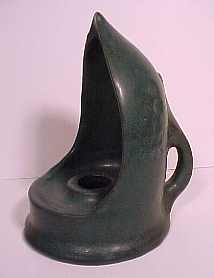
Van Briggle made candlesticks almost from the start. The earliest numbered design, a tall candlestick with molded leaves, is dated 1905, and in 1911 J. Emma Kinkead designed one with three lizards climbing the stem that now brings over $1,000. Most of what turns up today is later: pairs of tulip and double-tulip candlesticks in Ming Blue, turquoise, mulberry, and Persian Rose, made from the 1930s right through 2012.
A pair of mid-century tulip candlesticks typically sells for $30 to $100. The early designed pieces are another market entirely.
History & Designs
Early Numbered Designs (1905–1911)
Kathy Honea’s catalogue of Van Briggle design numbers at vanbrigglenotes.com records these early candle forms:
- #326 (1905): a tall candlestick with entwined leaves.
- #445 and #446 (1906): catalogued as “candlestick or vase,” possibly by Ambrose Schlegel. A documented #445 is 8¾ inches tall in mottled green and red.
- #562 (1907): a low candlestick holder with a finger ring, about 4 inches tall and 6 across. The documented example is royal blue with green overspray on chocolate clay.
- #785 (1909): a candlestick by Mae Cook, 8¼ inches.
- #869 Grapevine Candlestick (1911): by J. Emma Kinkead, a vine winding around a 12½-inch stem.
- #870 Three Lizards (1911): also by Kinkead, three lizards climbing a slender 13-inch candlestick. An example dated 1914, in matte blue, sold for $1,200 in 2022.
Teens-Era Candleholders & Sconces
Our Novelties guide shows a large matte green candleholder from 1915 (pictured above) found in an attic on Nevada Avenue, a 1917 candleholder that doubles as a sconce, and an owl night light that also held a candle. A ring-handle candle holder in an early brown glaze, which one Colorado collector calls “tobacco spit,” dates from the same period.
Production Candlesticks (1920s–2012)
From the 1920s on, candlesticks were standard production, usually sold in pairs. The forms that turn up most often:
- Tall pairs, 9 to 12½ inches, in matte blue, turquoise, mulberry, and blue-green, including a seven-sided Ming Blue pair from the 1920s.
- Tulip candlesticks, a single tulip cup on a short stem, 3⅝ to 8 inches, in red, Ming Blue, teal, turquoise, and mulberry.
- Double-tulip candlesticks, two cups on one base, about 4½ inches, usually turquoise or mulberry.
- Flower-bud and floraform sticks, leaf and three-leaf holders, trumpet-flower holders, and cornucopias.
- Anna Van Briggle gloss pieces from the mid-century line, such as horn candle holders and a tall Aladdin-lamp candle holder in Honey Gold.
The same molds stayed in use after the 1970 switch to buff clay, so a tulip pair can be from 1950 or 1990. Candlesticks are often found with a matching bowl and flower frog, and auction houses sell them together as console sets; see our Van Briggle bowls guide and flower frog guide.
Identifying & Dating Candlesticks
- Candlestick or bud vase? Some forms were made to be either; the 1906 designs are catalogued that way, and sellers list some tulip forms as “candlesticks or bud vases.” A shallow socket sized for a taper means candlestick. A deeper opening that holds water means it can be both. Our bud vase guide covers the vase side.
- Marks: early numbered pieces are incised with the AA monogram, “Van Briggle,” Colorado Springs, a date, and the design number. Later production carries the AA, “Van Briggle,” and usually “Colo Spgs.” Read them against our Van Briggle pottery marks guide.
- Clay: dark chocolate clay points to the early years, white clay to the 1930s through 1969, and buff clay to 1970 or later (see Clay Body History).
- Glaze: Persian Rose was discontinued before 1969, so a Persian Rose candlestick on white clay is mid-century. The Glaze Reference has dates for the others.
- Condition: look for wax staining inside the cups and small chips on the base edges of tall sticks, which are common. Warm water loosens old wax; our cleaning guide covers the rest.
Current Market Value
These ranges come from auction hammer prices, before buyer’s premium, between 2013 and 2026. A matched pair sells for more than two singles; in one 2026 sale a mulberry pair brought $80 and a single from the same collection $50.
| Type | Typical Sold Price | Notes |
|---|---|---|
| Early designed candlesticks (pre-1920) | $100–$1,200 | Kinkead’s lizard candlestick dated 1914 sold for $1,200; a dated 1919 single in Ming Blue for $100; a 1914 pair for $200. |
| Tall pairs, 9–12½ in. | $50–$350 | Usually $80–$225. A 10-inch matte blue pair catalogued as 1920s brought $350 in 2026. |
| Tulip & double-tulip pairs | $20–$150 | Usually $30–$100. Persian Rose pairs from the 1950s around $125. |
| Single candlesticks | $15–$100 | Small leaf holders at the bottom, dated early singles at the top. |
| Anna Van Briggle horn & Aladdin holders | $10–$30 | Gloss-glaze novelty forms. |
For values across all Van Briggle forms, see our Van Briggle value guide.
Where to Find Candle Holders
Tulip and tall pairs appear constantly at regional and estate auctions, often in mixed Van Briggle lots alongside a bowl and flower frog, where they are easy to win cheaply. eBay and Etsy carry plenty too; check sold listings before you offer, and ask for photos of the bottom of both pieces in a pair to confirm the glaze and marks match. The early designed candlesticks go through art pottery specialists and a few dealers such as JustArtPottery.com.
Own an early Van Briggle candlestick or a Kinkead lizard? We would like reference photos for this page. See our contact page.
Related Buying Guides
Explore our other Van Briggle buying guides for specific forms and the complete buying resource.
Complete Buying Guide
Where to buy, what to look for, values by era, and tips for building a collection.
← Back to guideLorelei Vase
Van Briggle’s most iconic design, the siren draped over the vessel rim. History, values, and where to find one.
Buying guide →Flower Frog
Scarab, fly, and snail figurals plus standard production. Some of Van Briggle’s most charming small pieces.
Buying guide →Tulip Vase
One of the most recognizable Van Briggle forms, produced across every era of the pottery’s history.
Buying guide →Bud Vase
Elegant small vases in Van Briggle’s signature matte glazes. Perfect starter pieces for new collectors.
Buying guide →Pitcher
Utilitarian pieces with Van Briggle’s Art Nouveau styling. Found across all eras of production.
Buying guide →Bookends
Early collectible bears, wolves, and owls plus late commercial squirrels, eagles, dolphins, and conquistadors.
Buying guide →Blue Vases
Turquoise Ming and the other Van Briggle blues, how the blue changed by decade, and sold prices.
Buying guide →Mulberry Vases
The deep red-purple used until 1946, and how to tell it from Persian Rose and later roses.
Buying guide →Lamps
Brass-shade art lamps, mid-century figurals with butterfly shades, and converted vases. How to tell them apart and what they sell for.
Buying guide →Animal Figurines
Kinkead’s 1916 bunny, mid-century elephants and donkeys, tall standing cats, and the Chimney Cat.
Buying guide →Bowls
Dragonfly bowls and their three-frog frogs, Siren of the Sea and Lady of the Lake centerpieces, console and rose bowls.
Buying guide →Indian Maiden & Indian Head
The three-face “Indian Head” vase, corn grinder figures, and the “Little Star” plaque.
Buying guide →Reference Books
Price guides, marks references, and histories for Van Briggle and the major American art potteries.
Browse the books →