Van Briggle Mulberry Vases
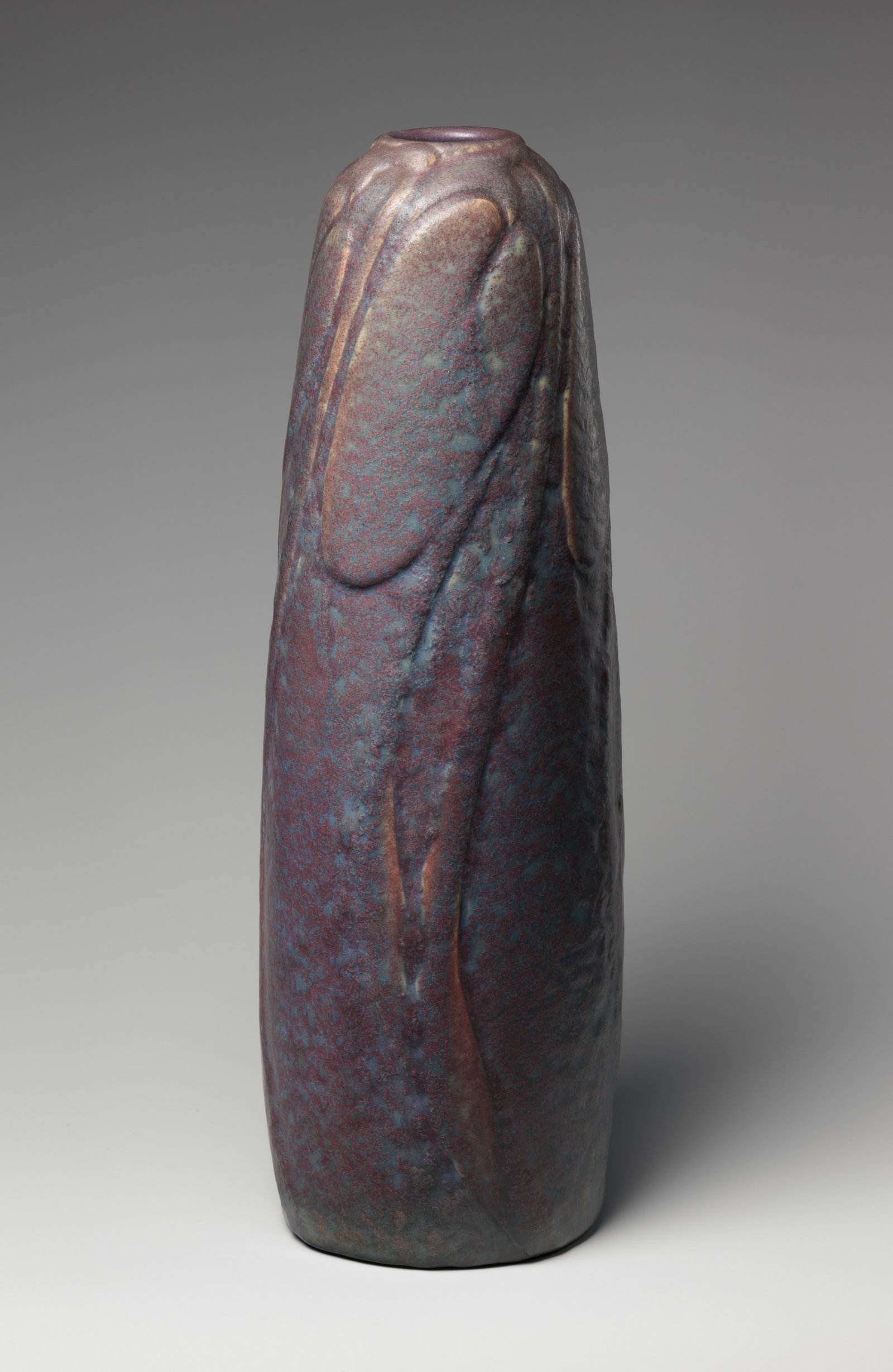
Mulberry is Van Briggle’s deep red-purple matte. It appears on the pottery’s earliest known color list, filed among the pinks next to a separate Dark Plum, and it was used from Artus Van Briggle’s first years until 1946, when the pottery lightened it into Persian Rose. Kathy Honea of vanbrigglenotes.com, writing about a 1917 piece, says fresh mulberries smashed onto the surface would be exactly this color.
That 1946 cutoff is the key to buying mulberry. A piece that looks mulberry but has post-1946 marks is almost certainly Persian Rose or a later rose or plum, and the true early mulberry pieces are worth much more.
Mulberry by Era
No early color brochures with glaze names survive, so collectors match early colors to names by eye. The descriptions below follow the glaze timeline at clemhull.com and the notes at vanbrigglenotes.com.
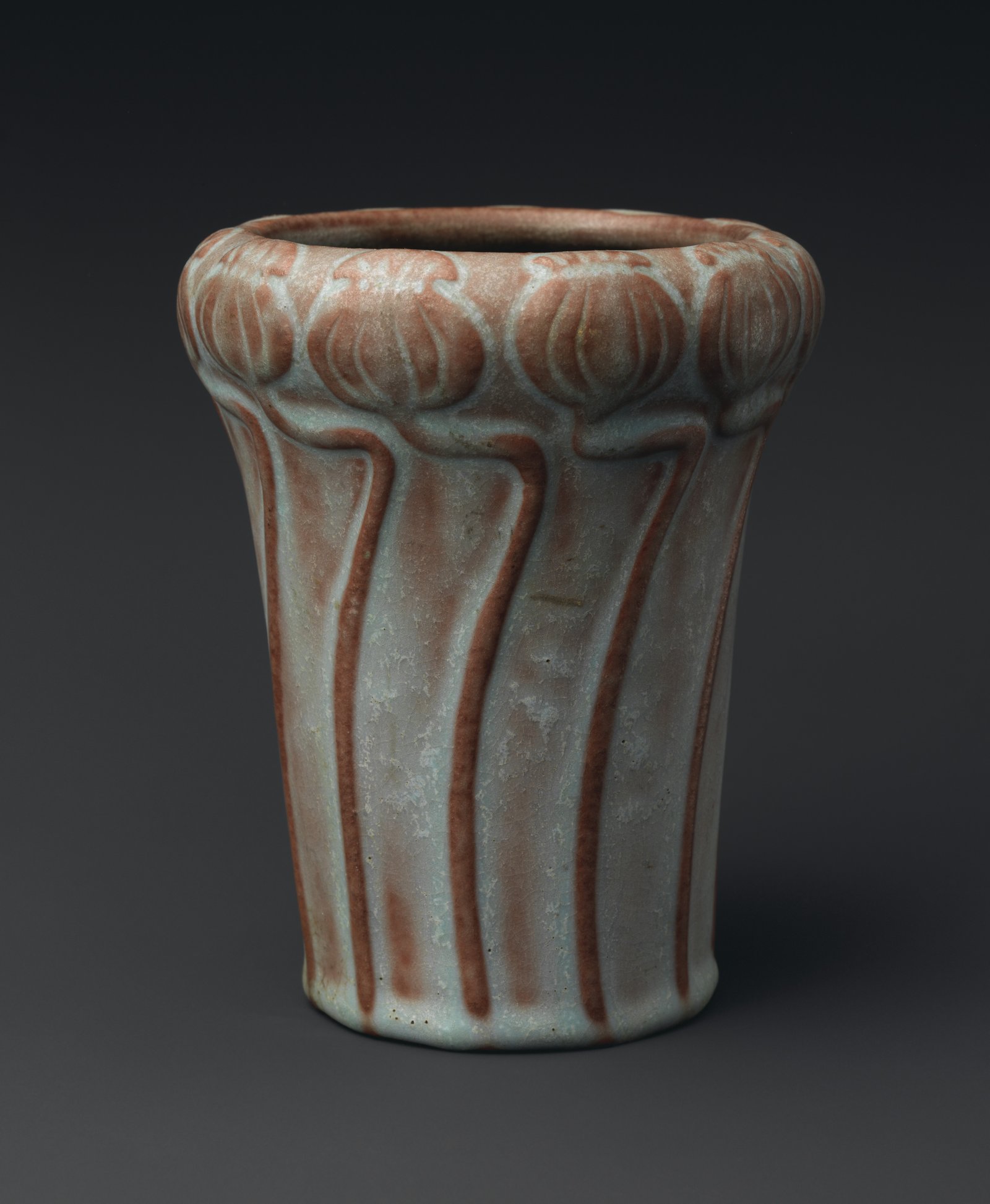
- 1902–1907: mulberry and purple, often with green highlights and the clay showing through on the relief. Auction catalogs describe pieces from these years as “mulberry,” “purple and green,” and, on a rare 1907 Dos Cabezas vase, “iridescent purple.”
- Teens: deep mulberry with a wide range of tone, and a common lighter combination with a heavy overspray of blue- or green-tinted white. Mulberry dragonfly bookends from 1917 carry an original $4 price sticker.
- 1922–1926 (“USA” mark): dark, rich mulberry with a deep maroon overspray.
- After 1926: lighter overall, with a blue overspray.
- 1930s to 1946: little overspray, and the color drifts rosier, toward what would become Persian Rose.
Mulberry turns up on early floral vases (poppies, crocuses, irises, daffodils, morning glories, leaves), the Dos Cabezas vase, the mermaid chalice, cyclamen and pine cone vases in the teens, USA-period cabinet vases, the “Indian Head” vase, bowls, candlesticks, flower frogs, bookends, and lamps. Mulberry was also used as an overspray, as on the 1920s mustard bear bookends in our bookends guide.
Mulberry or Persian Rose?
Persian Rose was introduced in 1946 as the replacement for mulberry, with a rosier base color and a blue overspray. In its first months it could be nearly as dark as mulberry, so even experienced collectors confuse the two. The bottom decides it.
- Marks: a dated bottom (to 1907), two-digit dates (1919–1921), or “USA” (1920s) put a piece in the mulberry years. Codes such as V5, A0, or VB100 mean 2000 or later. See the dating guide.
- Clay: mulberry sits on pre-1946 clay: varied bodies before 1920, sandy buff in the 1920s, fine white from the 1930s. White clay alone doesn’t settle it, since Persian Rose was also made on white clay until 1968. A buff body with a modern mark is post-1970. See Clay Body History.
- Overspray: green on early mulberry, maroon in the early 1920s, blue after 1926. Persian Rose has blue mottling over a pinker base.
Other Roses & Plums Sold as “Mulberry”
We know of no glaze called Mulberry after 1946. Later pieces listed as mulberry are usually one of these:
- Persian Rose, 1946 to 1968, and back in production by 2000.
- Desert Rose, 1982–1983, like Persian Rose without the blue mottling.
- Dusty Rose, introduced 1988, softer and paler, usually with blue mottling.
- Rose, made for about a year around 2007.
- Plum and Gray with Plum, 2000s.
Early purples are harder to name. The first color list has both Mulberry and Dark Plum, and a teens piece that has shifted toward purple can fairly be called either. Our Glaze Reference has swatches for each.
What Mulberry Pieces Sell For
These ranges come from Rago, Toomey & Co., Cottone, and Leland Little results between 2017 and 2026.
| Era | Typical Sold Price | Notes |
|---|---|---|
| 1902–1907 | $950–$4,500 | A 1903 vase catalogued as mulberry glaze brought $3,125; a 1903 morning glory vase, $4,480. Dos Cabezas vases have made $5,625 and $6,096. |
| 1907–1912 rare forms | $2,000–$5,500 | A 1907 peacock feather vase from the estate of Anna Gregory Van Briggle Ritter brought $2,000; a mermaid chalice, $5,525. |
| Teens | $325–$1,250 | A matte mulberry cyclamen vase from about 1915 sold for $325; a 1917 pine cone vase, $1,216. |
| 1920s | $375–$830 | USA-marked vases and the “Indian Head.” A Climbing Bear vase from about 1920 made $2,250. |
| 1930s–1946 | Groups $225–$420 | Usually sold in mixed lots. A tall matte mulberry table lamp brought $732. |
Auction prices swing: the same 1905 purple-and-green vase sold for $313 in 2017 and $875 when it was resold two years later. Read catalog glaze names with care too; one house described a vase from about 1920 as “Persian Rose,” a glaze not made until 1946. For all forms and eras, see our Van Briggle value guide.
Where to Find Mulberry Van Briggle
Early mulberry vases sell mostly through Rago and Toomey & Co., which catalog them by date and design number. Teens and 1920s pieces also turn up at regional auctions and with dealers such as JustArtPottery.com. Many later pieces listed online as mulberry are Persian Rose, so ask for a photo of the bottom before you buy.

We would like reference photos of 1920s and 1930s mulberry pieces with their bottom marks. See our contact page.
Related Buying Guides
Explore our other Van Briggle buying guides for specific forms and the complete buying resource.
Complete Buying Guide
Where to buy, what to look for, values by era, and tips for building a collection.
← Back to guideLorelei Vase
Van Briggle’s most iconic design, the siren draped over the vessel rim. History, values, and where to find one.
Buying guide →Flower Frog
Scarab, fly, and snail figurals plus standard production. Some of Van Briggle’s most charming small pieces.
Buying guide →Tulip Vase
One of the most recognizable Van Briggle forms, produced across every era of the pottery’s history.
Buying guide →Bud Vase
Elegant small vases in Van Briggle’s signature matte glazes. Perfect starter pieces for new collectors.
Buying guide →Pitcher
Utilitarian pieces with Van Briggle’s Art Nouveau styling. Found across all eras of production.
Buying guide →Bookends
Early collectible bears, wolves, and owls plus late commercial squirrels, eagles, dolphins, and conquistadors.
Buying guide →Blue Vases
Turquoise Ming and the other Van Briggle blues, how the blue changed by decade, and sold prices.
Buying guide →Lamps
Brass-shade art lamps, mid-century figurals with butterfly shades, and converted vases. How to tell them apart and what they sell for.
Buying guide →Animal Figurines
Kinkead’s 1916 bunny, mid-century elephants and donkeys, tall standing cats, and the Chimney Cat.
Buying guide →Bowls
Dragonfly bowls and their three-frog frogs, Siren of the Sea and Lady of the Lake centerpieces, console and rose bowls.
Buying guide →Candle Holders
From J. Emma Kinkead’s 1911 lizard candlestick to mid-century tulip pairs. Designs, marks, and sold prices.
Buying guide →Indian Maiden & Indian Head
The three-face “Indian Head” vase, corn grinder figures, and the “Little Star” plaque.
Buying guide →Reference Books
Price guides, marks references, and histories for Van Briggle and the major American art potteries.
Browse the books →