Van Briggle Lamps: Identification, Butterfly Shades & Value
Three different things get sold as a “Van Briggle lamp,” and they are worth very different amounts. A handful of art lamps with hand-worked brass shades came out of the pottery between 1903 and about 1909. Far more common are the mid-century lamp bases the factory cast for the purpose, many of them figural and sold with shades made of real butterflies and flowers pressed in plastic. The third group is vases that someone fitted with a cap and a socket after they left the pottery.
Most lamps on the market today are the mid-century kind, and most sell for under $200 at auction. Telling the three apart takes a look at the holes, the marks, and the shade.
History & Forms
Brass-Shade Art Lamps (1903–about 1909)
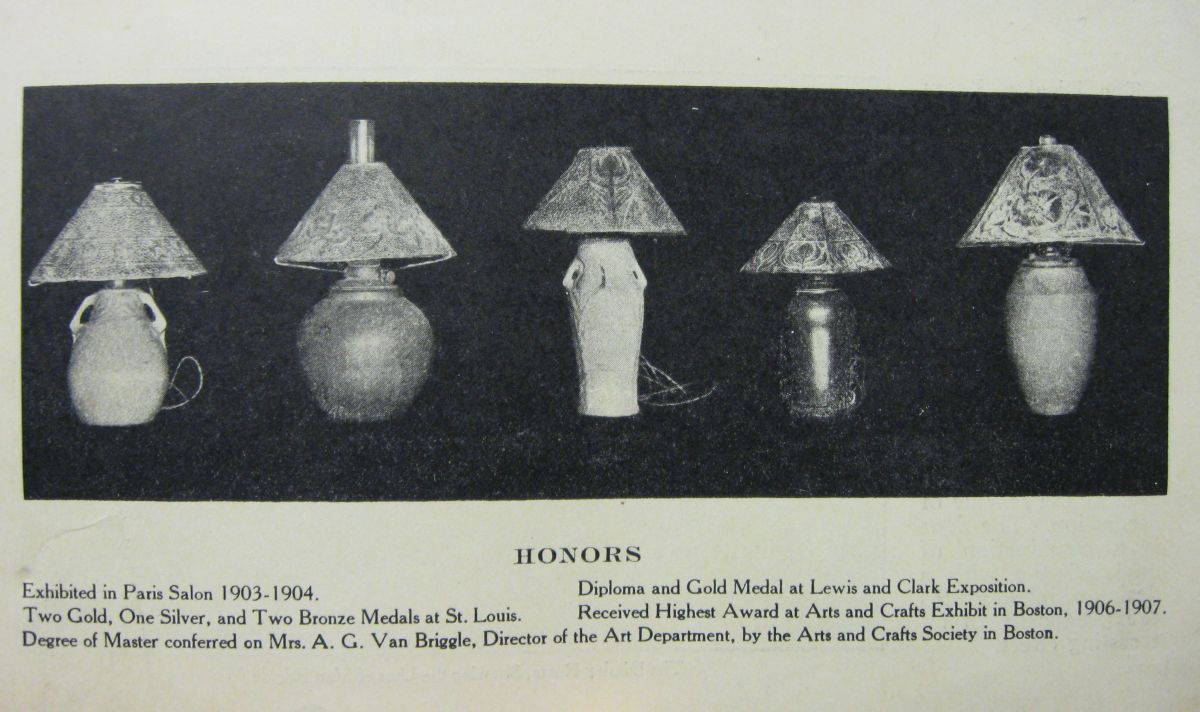
In the pottery’s first years, a few of Artus Van Briggle’s vases were made into lamps with patinated brass shades, punched and cut out to echo the patterns on the pots beneath them. Japanese metalworkers made the shades. The Kirkland Museum in Denver, now part of the Denver Art Museum, holds one built on the Poppies vase (design 143, inscribed 1903) and credits the shade to S. Riosetts Fujiura; it records 12 such lamps made between 1903 and 1909. The collector site vanbrigglenotes.com shows a second example on design 150 in a private collection and says lamps like these were shown at the 1904 World’s Fair in St. Louis. Our Ephemera page has an archive photo of a group of them.
These are museum pieces. No public sale of one turns up in recent auction records, so we don’t give a value for them here.
Factory Lamp Bases (1920s–1970s)
The pottery cast lamp bases as a regular product. A 1967 letter from the Van Briggle files, quoted on vanbrigglenotes.com, says the three-face Indian Head was modeled by Ambrose Schlegel in 1927 “for the purpose of a lamp base” and sold that way until about 1939. The Colorado Springs Pioneers Museum holds a plain turquoise lamp base from about 1935, engraved “Van Briggle, Colo. Spgs.”
From the 1940s through the 1960s the figural lamps took over. Forms documented in museum records and auction catalogs include:
- Figural women, sold under names such as the Damsel of Damascus (1940s, mulberry and green, about 13 inches of pottery), Rebecca at the Well (a woman filling a jug, 31 inches overall with shade), the Lady of the Calla Lily, a kneeling woman with an urn, and the Daydreamer (1948, by Nellie Walker, shown in Persian Rose).
- Animals and birds: an upright squirrel cast from the same molds as the bookends (Pioneers Museum, dated 1946–1950), a panther beneath a tree, swans in blue or white, a turquoise parakeet, two leaping deer, and a bird perched on a tree trunk.
- Butterfly lamps in Moonglo, enlarged from the design 688 butterfly bowl and made in the 1940s to 1960s. A matched pair is hard to find.
- Plainer bases: spherical, ribbed, and grape-and-vine forms, mostly in matte turquoise, plus small boudoir and vanity lamps.
A dragon lamp, factory drilled and glazed, is known from a few examples; a former Van Briggle potter who worked there from 1947 to 1988 placed it in the mid-century. Horse lamps are sold as Van Briggle, but we have not found one in a catalog or museum record, so treat that attribution with care until you have seen the marks.
Butterfly Shades
The original shades on mid-century lamps are panels of plastic with real butterflies, flowers, grasses, or milkweed seed pressed inside, stitched together with plastic cane. The Pioneers Museum squirrel lamp still has its pink-and-clear panel shade. Small clip-on versions, 6 to 7½ inches tall, were made for boudoir lamps. We have not found a record of who made the shades, the pottery or an outside supplier.
After 60 or more years, most of these shades have yellowed, buckled, split at the seams, or lost butterfly wings. An original shade in good condition adds to a lamp’s value; a damaged one still tells you the lamp is probably original.
Other Van Briggle Lighting
The pottery also made candleholders, wall sconces, a hooded electric light, and an owl night light in the teens era. Photos and notes are in the Lighting section of our Novelties guide, and candle forms have their own candle holder guide.
Made as a Lamp, or Converted?
This is the first question to answer, because it decides which market the piece belongs in.
- Factory lamp base: the opening for the lamp pipe and the hole for the cord were formed in the clay before firing and are glazed over. Figurals often have the holes built into the sculpture, such as the squirrel lamp’s openings at the base and at the tip of the tail.
- Converted vase: a cap fitted over the mouth, with the cord running through the cap and an undrilled bottom. If a hole was drilled later, its edge usually cuts cleanly through the glaze and shows raw clay.
- Early dated pieces: a vase with a 1902–1912 date or early design number that is now a lamp was almost always converted after it left the pottery. The brass-shade lamps above are the exception. A 1903 vase catalogued as a “vase / lamp base” sold at Toomey & Co. in 2024 for $2,520, priced as early art pottery, not as a lamp.
Marks on Lamps
Lamps carry the same marks as other Van Briggle ware: the AA monogram, “Van Briggle,” and often “Colo. Spgs.” On figural lamps, look on the back or side of the base near the cord hole as well as underneath, because the mark is often there. Many mid-century lamps were never signed, and an unsigned lamp is an attribution, not a confirmed Van Briggle. Our Van Briggle pottery marks guide and dating guide cover what each mark style means.
Clay and Glaze
Where the clay is visible, use the same rule as the rest of the ware: white clay before 1970, buff after (see Clay Body History). Mid-century lamps are usually in matte turquoise, Persian Rose, mulberry, blue, or Moonglo white, all covered in the Glaze Reference.
Wiring: some lamps still have their original cords, but old cloth or rubber wiring is a fire risk. Plan to rewire before using one. A lamp rewire kit with socket, cord, and harp covers most table lamps. Keep the original parts if you replace them; a lamp that has been rewired sells fine, but a collector will want to know.
Van Briggle Lamp Price Guide
These ranges come from auction results between 2009 and 2024. Mid-century lamps regularly sell below their low estimates, so asking prices of $300 to $600 at dealers and on marketplaces are well above what most of them bring at auction.
| Type | Typical Sold Price | Notes |
|---|---|---|
| Small boudoir, vanity & butterfly lamps | $35–$100 | Turquoise or blue, often with a small butterfly shade. A turquoise butterfly lamp with its shade sold for $100 in 2022. |
| Standard mid-century table lamps | $50–$175 | Plain or lightly figural bases. Eldred’s sold one for $175 hammer ($224 with premium) in 2024. |
| Large figural lamps with original shade | $150–$350 | A 45-inch lamp with a worn butterfly shade brought $352 in 2022; a panther and a kneeling woman sold together for $300. |
| Early vase made into a lamp | $2,500+ | Priced as early art pottery. A 16-inch 1903 piece sold for $2,520 in 2024. |
| Brass-shade art lamps, 1903–1909 | No recent public sale | Museum-level rarity. |
What moves the price: the original shade in good condition, a clear mark, a named figural form, and size. A lamp with a missing finial, a cracked shade, or no mark sits at the bottom of its range. For values across all Van Briggle forms, see our Van Briggle value guide.
Where to Find Van Briggle Lamps
Regional Auctions
Most of the sold prices above came from regional and estate auction houses, where lamps turn up a few at a time and often go under estimate. Crafted Auction in Illinois, connected to JustArtPottery.com, runs Van Briggle-heavy sales that include lamps and even loose butterfly shades.
Estate Sales
Lamps were bought new at the pottery shop by tourists and Colorado families from the 1940s on, and many have sat in the same house since. Online estate sale sites and local estate sales are good hunting grounds, especially in Colorado and the Mountain West.
eBay, Etsy & Dealers
Marketplaces always have a few listed. Asking prices run $100 to $600, so check eBay’s sold listings before you offer, and ask the seller for photos of the base, the cord hole, and the inside of the shade.
Specialist Auctions
Early pieces that have been made into lamps belong at art pottery specialists such as Toomey & Co. and Rago, where they are catalogued by design number and date.
Frequently Asked Questions
Did Van Briggle make lamps, or are they all converted vases?
Both exist. The factory cast lamp bases with glazed-over holes for the pipe and cord, and the Indian Head was designed as a lamp base in 1927. Vases were also capped and wired by owners and dealers later.
Is the butterfly shade original?
If it is plastic panels with real butterflies, flowers, or seeds inside, stitched with plastic cane, it matches the shades sold with mid-century Van Briggle lamps. Shades were often swapped over the years, so a matching shade is likely but not proof.
Why is my lamp not signed on the bottom?
Check the back and sides of the base near the cord hole; figural lamps were often marked there. Many mid-century lamps were never marked at all.
Is a Van Briggle lamp shade worth anything on its own?
Some. Original butterfly shades sell as replacements for lamps that lost theirs, but an unsigned 1950s shade failed to sell at a $150–$200 estimate in 2025, so expect less.
Own a Van Briggle lamp with its original shade? We would like to add reference photos of mid-century lamps to this page. See our contact page.
Related Buying Guides
Explore our other Van Briggle buying guides for specific forms and the complete buying resource.
Complete Buying Guide
Where to buy, what to look for, values by era, and tips for building a collection.
← Back to guideLorelei Vase
Van Briggle’s most iconic design, the siren draped over the vessel rim. History, values, and where to find one.
Buying guide →Flower Frog
Scarab, fly, and snail figurals plus standard production. Some of Van Briggle’s most charming small pieces.
Buying guide →Tulip Vase
One of the most recognizable Van Briggle forms, produced across every era of the pottery’s history.
Buying guide →Bud Vase
Elegant small vases in Van Briggle’s signature matte glazes. Perfect starter pieces for new collectors.
Buying guide →Pitcher
Utilitarian pieces with Van Briggle’s Art Nouveau styling. Found across all eras of production.
Buying guide →Bookends
Early collectible bears, wolves, and owls plus late commercial squirrels, eagles, dolphins, and conquistadors.
Buying guide →Blue Vases
Turquoise Ming and the other Van Briggle blues, how the blue changed by decade, and sold prices.
Buying guide →Mulberry Vases
The deep red-purple used until 1946, and how to tell it from Persian Rose and later roses.
Buying guide →Animal Figurines
Kinkead’s 1916 bunny, mid-century elephants and donkeys, tall standing cats, and the Chimney Cat.
Buying guide →Bowls
Dragonfly bowls and their three-frog frogs, Siren of the Sea and Lady of the Lake centerpieces, console and rose bowls.
Buying guide →Candle Holders
From J. Emma Kinkead’s 1911 lizard candlestick to mid-century tulip pairs. Designs, marks, and sold prices.
Buying guide →Indian Maiden & Indian Head
The three-face “Indian Head” vase, corn grinder figures, and the “Little Star” plaque.
Buying guide →Reference Books
Price guides, marks references, and histories for Van Briggle and the major American art potteries.
Browse the books →